News & Media
Sharing African expertise: Unisa, ZOU to collaborate
On Thursday 18 August 2022, the University of South Africa (Unisa) hosted a gala dinner during which a memorandum of understanding (MOU) was concluded between itself and the Zimbabwe Open University (ZOU). The dinner was part of the 44th Board Meeting of the African Council for Distance Education (ACDE), hosted by Unisa.
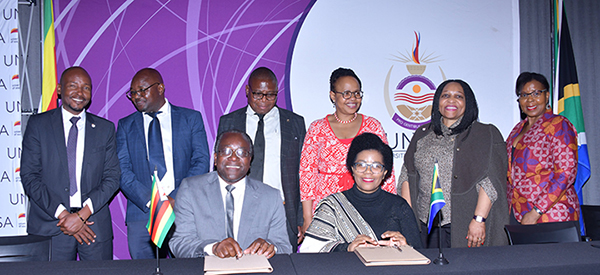
Signing the MOU were (front, from left) Prof Paul Henry Gundani, ZOU Vice-Chancellor, and Prof Puleng LenkaBula, Unisa Principal and Vice-Chancellor. Looking on are Unisa and ZOU representatives.
The main thrust of this bilateral agreement includes, among others, pedagogical and scientific exchange of lecturers, researchers and students (undergraduate and postgraduate), sharing teaching and training programmes, as well as collaboration in many other areas.
The agreement further makes provision for implementation mechanisms to facilitate the identification of priority areas as well as implementation of the agreement itself.
Speaking after the signing of the agreement, Prof Puleng LenkaBula, Unisa Principal and Vice-Chancellor, said that the signing of the MOU is in line with South Africa’s National Development Plan which sets aspirations for South Africa to develop its intellectual leadership in various sectors.
"It also speaks to our relationship with member countries of the Southern African Development Community and the continent as a whole," she said. "As a university we do not exist solely for knowledge production. It was imperative that we develop partnership with ZOU, and key to this relationship is strengthening our research agenda to ensure that it speaks to the grand idea and solutions South Africa requires."
LenkaBula said that the second aspect of importance is that the aftermath of Covid-19 has demonstrated that the comprehensive open, distance and eLearning (ODeL) approaches are more valuable, viable and valid for the continent. "These two universities are the pivotal point for ensuring quality," she continued. "Many universities, especially contact universities, thought that by posting their materials online and using WhatsApp to communicate to students they were doing eLearning, but we know as these two universities that it is pedagogy and other associated aspect that we must strengthen so that the quality acceptance, relevance and transformative impact of our educational system are impacted positively."
LenkaBula expressed her appreciation of the ZOU Vice-Chancellor, Prof Paul Henry Gundani, for seeing the importance of the collaboration between the two universities for the benefit of the African continent. She also highlighted the importance of the support for this initiative received from the Minister of Higher Education, Science and Innovation, Dr Blade Nzimande, and the Minister of International Relations and Cooperation, Dr Naledi Pandor.
Explaining how and why the collaboration came about, Gundani said: "The fact that I was at Unisa for 17 years is testimony that I have learnt a lot about ODeL. I came to Unisa from a contact university, the University of Zimbabwe. I understood a little bit but when I came to Unisa, I got immersed into ODeL pedagogy and I appreciated every important aspect of Unisa. It is the oldest ODeL university in the world, turning 150 years soon. This speaks to the vast experience that Unisa has, as is evident in the solutions that have initiated over one-and-a-half centuries. Unisa has vast resources, not only technologically but also in terms of human capital. Having worked at Unisa, when I got to ZOU, I thought it would be remiss of me to cut the umbilical cord, having appreciated what the institution can offer as the mother of distance education in the world."
Gundani said that part of the envisaged collaboration is to reconnect so that the two institutions can share and learn from each other. "This cooperation is important because it gives us an opportunity not only to interface and share, but to walk together and seek solutions for our society. Our communities have always worked together, not for decades but for centuries, and this is one way of appreciating that, as universities, and at an intellectual higher level, we can nurture this relationship."
* By Edgar Rathelele, Senior Media Officer, Department of Institutional Advancement
Publish date: 2022/08/19

 Unisa co-hosts G20 community outreach in the Eastern Cape
 Unisans gain membership of prestigious science academies
 Unisa alumna takes the helm at the SA Library for the Blind
 Advocating for disability transformation through servant leadership
 Unisa Press continues to illuminate the publishing space