News & Events
Presenting digital access to support Unisa students
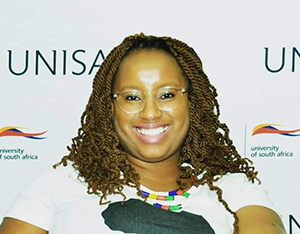
Phindiwe Kamolane (Unisa CAS Senior Lecturer)
Phindiwe Kamolane, from the Auditing Department in the College of Accounting Sciences (CAS), shared the successes and challenges of online student support in the context of a comprehensive, open distance e-learning (CODeL) environment.
Reflecting on the university’s services, Kamolane acknowledged first that the topic of digital access is sensitive given Unisa’s mandate to provide access to education. She indicated through figures the number of students who do have access to data. According to Kamolane, the university is working on a five-year investment plan to assist both students and staff with data – to access services required for education and work activities. “We cannot be blind to the reality that the Fourth Industrial Revolution (4IR) is with us.”
In her presentation titled Access in the context of 4IR and digitisation, Kamolane highlighted the fact that digital skills are no longer for information communication technology (ICT) practitioners only. “Our day-to-day activities such as the usage of smart phones, being on Microsoft Teams and using productivity documents like Word, Excel, tells that we have already infused the digital skills that we need for the future.”
Furthermore, Kamolane emphasised the need for the university’s graduates to adopt digitally oriented thinking and innovation for workplace readiness. This, she said, “poses the question to the new value proposition that Unisa has to bring within this environment. Our teaching and curricular needs to be underpinned by digital technology.”
“Connection to the internet assist students to succeed in a distance learning environment,” said Kamolane. “We alert students that we communicate via distance in a digital format. They should have a computer and internet to study with Unisa.” She also informed the audience about digital divide and the South African digital population statistics. “We found that most of our internet users access the internet through cellphones.”
Kamolane pointed out the kind of support the university is giving to its students. “We provide digital access centres targeting students who reside in remote rural areas and students who are far from regional centres,” she said. “We give all the support to ensure that our students are not negatively affected by their socio-economic environment.”
Concluding her presentation, Kamolane mentioned key partners of the university in providing access and necessary infrastructure to enable digital skills.
*By Lesego Chiloane-Ravhudzulo, Journalist, Department of Institutional Advancement
Publish date: 2022/03/28