News & Events
Reinforcing global dialogue on the future of learning
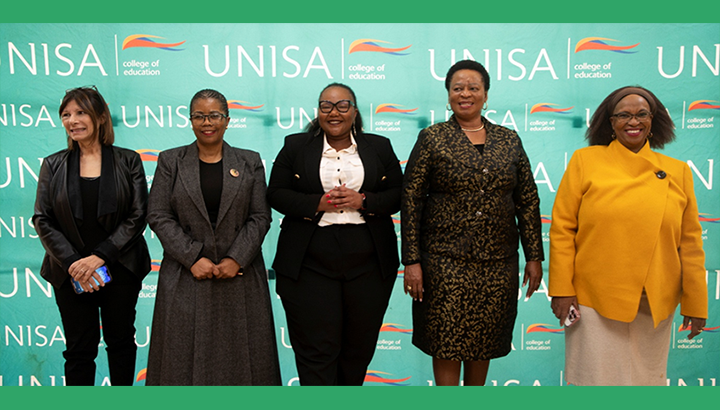
From left: Prof Veronica McKay, Prof Puleng LenkaBula, Minister Siviwe Gwarube, Deputy Minister Dr. Reginah Mhaule, and Prof Mpine Makoe
Unisa, in collaboration with the Department of Basic Education, hosted the G20 Education Seminar under the theme From dialogue to implementation. Held at Unisa’s Muckleneuk Campus on 12 August 2025, the event brought together leading voices in education to chart a transformative path for learning systems across the country and the globe.
The seminar formed part of South Africa’s G20 Presidency and focused on translating policy dialogue into actionable strategies for inclusive, equitable, and future-ready education. The programme chaired by Professor Mpine Makoe, Executive Dean of Unisa’s College of Education (CEDU), provided fruitful insights featuring keynote addresses, as well as panel and collaborative discussions.
Distinguished keynote speakers
Professor Puleng LenkaBula, Unisa’s Principal and Vice-Chancellor (VC), welcomed delegates with a powerful address highlighting the university’s commitment to global educational equity.
Following the VC’s address, Honourable Siviwe Gwarube, Minister of Basic Education, delivered a compelling keynote address on the national vision for foundational learning and professional development. Additionally, Honourable Dr Reginah Mhaule, Deputy Minister of Basic Education, offered an overview of the G20 Education Working Group’s priorities, emphasising South Africa’s leadership role.
Spotlighting provocative discussions
The first panel, chaired by Professor Hasina Ebrahim, Unisa’s UNESCO Co-chair for Early Childhood Education, Care and Development, focused on Quality foundational learning. Other experts explored early childhood care and education as a global imperative, with discussions on inclusion, language, and innovation. Panellists included:
- Professor Shonisani Mulovhedzi (University of Venda) on language and inclusive practice
- Dr Mzoli Mncanca (Unisa) on play, care, and learning
- Michelle Mathey (Department of Higher Education and Training) on professional development
- Professor Mary Clasquin-Johnson (Unisa) on inclusion in early years
The second panel, led by Professor Veronica McKay, CEDU’s Professor Extradordinarius, tackled the theme Professional development for a future-ready workforce. The discussion highlighted teacher wellness, peer support, and the integration of 21st century skills. Contributors included:
- Professor Lee Rusznyak (University of the Witwatersrand) on professional practice
- Gerrit Coetzee (Flemish Association for Development Cooperation and Technical Assistance) on collaborative support
- Lala Maje (Department of Basic Eduction) on initial teacher education
- Dr Beverly Feldman (Unisa) on teacher wellness
A subsequent panel chaired by Cheryl Weston and Tsekere Maponya of DBE, delved into digitalisation, artificial intelligence, and science, technology, engineering, and mathematics (STEM) in initial teacher education, featuring insights from Professor Piera Biccard (Unisa), Dr Aaron Nkosi (DBE), Professor Meahabo Magano (Unisa), and Professor Awelani Mudau (Unisa).
Call to action and a platform for change
The intensive seminar also served as a catalyst for shaping the future of education. It reaffirmed the importance of collaboration, innovation, and resilience in building learning systems that serve all learners.
The event concluded with a facilitated feedback session led by Professor Ramodungoane Tabane, Director of Unisa’s School of Educational Studies, encouraging universities to move from dialogue to implementation. A summary report was presented by Professor Victor Pitsoe from Unisa, followed by a call to action by Dr Godwin Khosa, Chief Executive Officer of the National Education Collaboration Trust.
* By Seanokeng Kgaphole and Kebalebile Motsepe, Marketing Assistants, College of Education
Publish date: 2025/09/05