
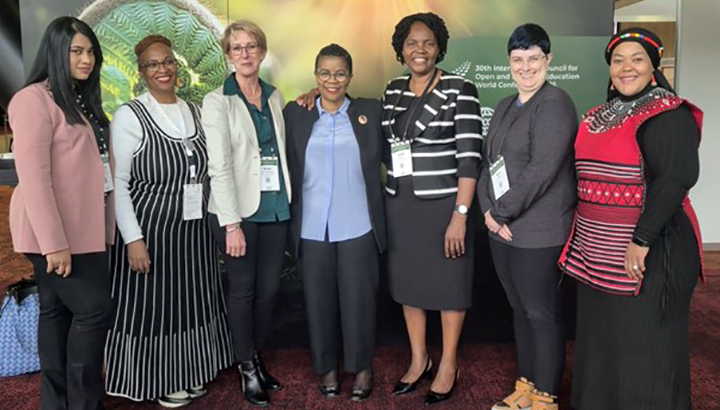
From left: Prof Kershnee Sevnarayan, Prof Mpine Makoe, Prof Geesje van den Berg, Prof Puleng LenkaBula, Prof Ashley Mutezo, Dr Sune Mare and Prof Sindile Ngubane
The Unisa delegation, led by Prof Puleng LenkaBula, Principal and Vice Chancellor (VC), attended the 30th International Council for Distance Education (ICDE) World Conference recently held in November 2025, themed Ako: Exchanging ideas for inclusive, scalable, and sustainable education.
In her keynote address, LenkaBula challenged institutions of higher learning to move beyond technocentric models, but to also build ecologies of care that honour diverse knowledge systems, languages and lived realities.
Drawing a powerful connection between the Māori concept of Ako, the idea that teaching and learning are reciprocal, and the value of Ubuntu (I am because we are), LenkaBula said that a truly inclusive education must be rooted in relationality, shared humanity and epistemic justice. She argued that education cannot be about technology alone, but it must also be about human connection, respect for diverse knowledge systems and continuously enhancing social justice.
The conference attracted hundreds of global thought leaders, practitioners and policymakers in open distance and digital education from more than 50 countries. It was centred on equity, indigenous epistemologies, responsible artificial intelligence (AI) integration and the resilience of future-focused education systems.
LenkaBula further stated that growth in education is futile if it comes at the cost of equality and inclusion. "From Ako to Ubuntu", the message was clear that human-centred, inclusive, ethical and socially just education is not optional, but is essential. She emphasised: "Unisa’s commitment to Africanising knowledge, advancing equity across borders and leading with purpose remains at the heart of our work; shaping not only the future of distance learning, but of education itself."
Additionally, the VC reaffirmed Unisa’s commitment to advancing social justice and leading with moral purpose in an era of digital transformation. Her message provided a grounding framework for delegates and set the tone for the conference discussions on AI, access, inclusivity and innovation.
Unisa was profoundly influential at the conference through the words and work of its delegation. Prof Mpine Makoe, Executive Dean of the College of Education (CEDU), played a pivotal role as the ICDE board member and one of the esteemed scholars who contributed a chapter in a book titled Mega universities and opening education by design, which was also launched at the conference.
Prof Sindile Ngubane from CEDU’s Institute of Open Distance Learning was the lead facilitator of the ICDE Global Doctoral Consortium. The consortium is one of Unisa’s legacy projects where postgraduate students from across the globe gather to share their work among peers and experts at every ICDE conference.
Prof Kershnee Sevnarayan from the Department of English Studies, said: "As AI transforms ODeL, our mission remains unchanged, which is education with a human touch that is guided by empathy, equity and the belief that every student belongs." Prof Geesje van den Berg, CEDU’s Commonwealth of Learning Chair, noted that many presenters stressed the danger of treating AI as a neutral or universal tool. "One powerful message kept returning, if we do not embed critical digital literacy at the core of our curriculum, we risk automating inequality," she said.
According to Prof Ashley Mutezo and Dr Sune Mare from the College of Economic and Management Sciences, the ICDE Technology and Innovation Network Workshop was valuable, which modelled real-time, cross-border collaboration through problem-solving with peers from diverse education ecosystems. They described the conference as a global meeting place to exchange knowledge, practices and visions for the future of education.
* Compiled by Freddy Abilio Mlambo, Communication and Marketing Specialist, College of Education, with contribution from the Unisa delegation
Publish date: 2025/12/11

 From prison graduate to aspiring chartered accountant
 Science Campus hosts successful international conference
 Perseverance pays off for visually impaired student
 Embracing and promoting multilingualism
 Unisa alumna pursues her dream with determination