

The African college of excellence in the social and human sciences

The delegation was introduced to marimbas, mbiras, traditional bows, drums and assorted percussion instruments from across Africa
On 1 June 2026, the Department of Art and Music, in the School of Art, College of Human Sciences, at the University of South Africa (Unisa), welcomed a South African Music Technology and Innovation Capacity-Building (SAMTIC) delegation, alongside visiting partners from Sofia University St Kliment Ohridski (Bulgaria) and the Hochschule für Musik Nürnberg (Germany). Accompanying the guests to Unisa were representatives from Tshwane University of Technology (TUT), the University of Pretoria (UP) and Wits. The day combined hands-on music-making, archival access, and conversations about technology, pedagogy and preservation.
The purpose of the workshop was to expose participants to African instruments in an ensemble workshop under the guidance of leading African music practitioner Volley Nchabeleng, known for his work on Shaka iLembe, at the Dr Miriam Makeba Concert Hall.
The delegation was introduced to marimbas, mbiras, traditional bows, drums and assorted percussion instruments from across Africa. Nchabeleng emphasised technique, social context and regional performance practices, inviting the visiting musicians to learn the playing methods on display and situate the sounds within their cultural logics.
A live audio recording of the event was made by Dr Christopher Jeffery, a composition and music technology lecturer in the department, using equipment acquired through the SAMTIC project’s Erasmus+ funding grant. Karabo Aphane, a multimedia lecturer, produced archival-quality video of the event for legacy projects, teaching and research purposes.
After the workshop, the group toured the African Reunion exhibition at the Unisa Art Gallery, led by curator Tshegofatso Seoka. The exhibition, with its themes that present elements of material culture, complemented discussions about instruments as vehicles of communal narratives and informed ideas for collaborative display practices between galleries and music departments.
Delegates then visited Unisa’s Multimedia Centre, currently being developed layer by layer into a digital audiovisual hub and were guided through the facilities by production technician Roland Mauries. Plans for recording studios, digitisation suites and performance spaces attracted interest as potential sites for joint residencies, student exchanges and collaborative projects in African music technologies.
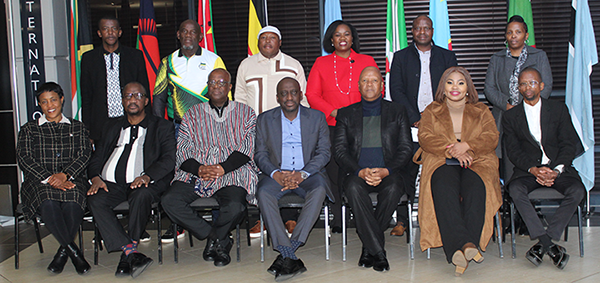
From left: Prof Toni Hinterholzinger (Hochschule für Musik Nürnberg), Jens Petzold (Hochschule für Musik Nürnberg), Ndabo Zulu (Unisa), Prof Karendra Devroop (TUT SAMTIC project lead), Dr Phuti Sepuru (Unisa), Collette Isaacs (Unisa), Prof Vaselin Karaatanasov (Sofia University St Kliment Ohridski), Polliana Sattler (Hochschule für Musik Nürnberg), Prof Thomas Pooley (Unisa), Dr Annemie Behr (Unisa), Dr Chris Jeffery (Unisa), Prof Adrian Georgiev (Sofia University St Kliment Ohridski), Prof Hristo Karagyozov (Sofia University St Kliment Ohridski), Volley Nchabeleng (African music practitioner), Dr Roland Moses (TUT), Dr Evans Netshivhambe (Unisa) and Dr Daniel Mosako (Unisa)
A highlight of the visit was the stop at the Harold and Eda Steafel Instrument Collection, housed in the Unisa Library archives. There, Anri van der Westhuizen and the archival team presented early recording devices, rare instruments and conservation practices, allowing delegates to study them closely.
Strategic marketing presentations for the Department of Art and Music were delivered by Unisa Art and Music staff members, who tied the day’s activities to teaching, research and publication. Dr Annemie Behr outlined integrated approaches to music tuition and Ndabo Zulu showcased advances in music technology and its role in documenting traditional practices. Dr Evans Netshivhambe provided scholarly context on African music at Unisa, while Dr Phuti Sepuru discussed opportunities for the Art and Music Department’s Scopus-listed Musiki journal to feature outputs from the visit. Dr Chris Jeffery’s talk on music and AI raised ethical and methodological questions for computational approaches to sonic heritage.
SAMTIC’s coordinating role proved central to the visit’s impact and to plans for future collaboration across the network. As a hub combining music technology, preservation and pedagogy, SAMTIC enabled partners across countries and South African universities to align workshop, recording and archival activities into a coherent research agenda. Delegates emphasised three strategic contributions provided by SAMTIC: it acted as a convening platform, connecting practitioners, technologists and curators and thereby enabling multi-institutional projects and student exchanges; it functioned as a resource and capacity builder, supplying equipment, funding and training frameworks that support high-quality documentation and the upskilling of students and archivists; and it served as a research and dissemination node, promoting interdisciplinary outputs that transform recordings and archival materials into pedagogical modules, publications and exhibitions.
These capacities directly shaped the proposed next steps discussed at the event. Participants outlined plans for joint workshops across SAMTIC partners, the creation of a shared audiovisual repository with standardised metadata for African instruments, collaborative grant applications targeting digital preservation, and a regional symposium on ethical AI in musicology. Delegates stressed the importance of embedding students and early-career researchers in these initiatives to ensure sustainable knowledge transmission and long-term stewardship.
The organisers framed the visit as an extension of the Music Foundation’s African Music Festival initiatives, which foreground bow and marimba traditions. The current engagement broadened that remit by bringing instruments from Northern, Eastern, Southern, Western and Central Africa into shared practice. Delegates observed that active ensemble playing fostered a deeper appreciation of instruments’ “in situ” meanings than passive observation.
As the day ended, participants expressed optimism about long-term outcomes. The mix of performance, curation and technological discussion modelled an interdisciplinary approach to musical heritage. For Unisa, the visit reinforced its role as a site for international collaboration; for visiting partners, it provided an immersive introduction to African instrumental traditions and institutional infrastructures. With SAMTIC at the centre, the recordings and relationships produced during the visit will support coordinated research, training and preservation efforts across the network, helping to sustain instrument knowledge while expanding scholarly and creative partnerships.
* By Dr Christopher Jeffery, Senior Lecturer, and Daniel Rankadi Mosako, Acting Chair, Department of Art and Music
** Photos by Karabo Aphane
Publish date: 2026/07/02

 Unisa hackathon winners develop AI solution to support students at risk of falling behind
 Beyond Black Wednesday: Unisa lecture calls for urgent action to protect media freedom and public broadcasting
 Unisa celebrates 25 new PhD graduates advancing research and innovation
 From Maramanzhi to master's: Unisa graduate champions Tshivenda through scholarship
 Unisa students help shape digital complaints system to improve accountability and service delivery