News & Media
'Achieving effective women's rights requires solidarity'
In celebration of Women’s Month, Unisa and South African Women in Dialogue (SAWID), held their 8th annual Women’s Dialogue on 18 August 2023 at the university’s main campus. Themed "Celebrating milestones, offering solutions: South African women’s priorities and action plan for a sustainable future", the dialogue called on all role players in the country – government, business and civil society – to stand in solidarity and act with urgency to establish a consolidated programme for women’s safety, security and economic development.
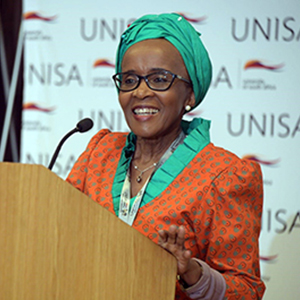
Thoko Mpumlwana
Established in 2016, the partnership between Unisa, SAWID and United Nations Women has strengthened the interaction platform of South African women and has magnified their voices on platforms where decision-making affects their lives. The event, therefore, celebrated this partnership and explored feminist solutions to ongoing national, continental and global challenges. It further called on strengthening the feminist women's movements towards political, economic and societal transformation in the country.
Women are the source of transformation
Speaking about the partnership and SAWID’s 20th celebration this year, Thoko Mpumlwana, SAWID’s Chairperson, lauded Unisa’s Principal and Vice-Chancellor, Prof Puleng LenkaBula, for her resilient leadership and thanked the university for providing the organisation with a home. Mpumlwana also acknowledged former South African first lady, Dr Zanele Mbeki, as SAWID’s patron and attested that her leadership ability inspires the organisation to build courage and solidarity, and help others. She further expressed her appreciation for the organisation’s various stakeholders who continuously provide support and empower others.
Mpumlwana remarked: "A SAWIDian is a problem solver, self-reliant, and an agent of development and peace, and, in the quest for transformation, builds solid families and communities that shape the next generations." She added: "As we reflect on the journey that we have travelled together, let us join hands and celebrate each other’s success."
Women empowerment for economic freedom
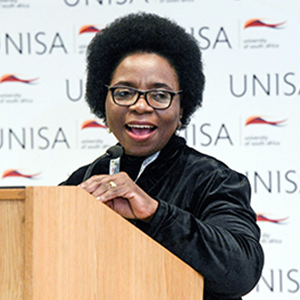
Prof Meahabo Magano
Prof Meahabo Magano, Chairperson of the Unisa Women’s Forum, said: "Today’s commemoration focuses on remarkable achievements, indomitable spirit, and invaluable contributions of women in shaping our society." She added: "This occasion not only pays tribute to the past struggles of women, but it also serves as a reminder of the ongoing journey towards gender equality, empowerment, and leadership." Magano also paid tribute to lionised South African women such as the late Winnie Madikizela-Mandela, Charlotte Maxeke (late), and Miriam Makeba (late), whom she also referred to as beacons of hope that shaped South Africa’s history.
Aligning her message to Unisa’s 150th anniversary celebrated this year, Magano affirmed: "As academics, researchers and thought leaders, we have a unique responsibility of shaping narratives, challenging the norms and advancing knowledge that promotes women’s rights and leadership." She reiterated the value of harnessing the power of education to foster a more inclusive and just society, and to fight for a better future. Magano commended former acting Executive Director of SAWID and author, Madumezulu Girlie Silinda, who was among the attendees, for her recent publication that focuses on women in poverty and encourages them not to rely on men who could abuse them.
Thereafter, an audiovisual recording highlighting Unisa’s commitment to enhancing women empowerment and skills development through, among others, community engagement projects and engaged scholarship, was presented.
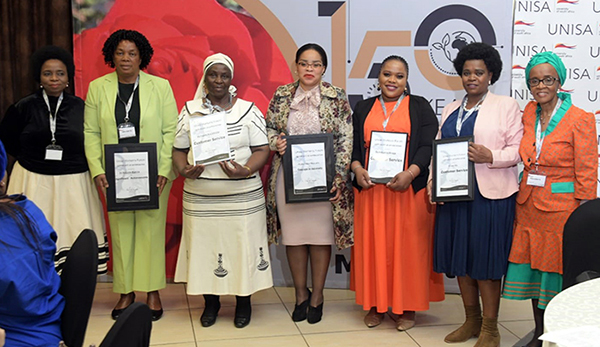
Prof Meahabo Magano (far left) and Thoko Mpumlwana (far right), together with award recipients who were acknowledged for their impactful contributions in various areas
Women solidary for a just society
Human rights activist, United Democratic Front (UDF) representative, and Professor of Development Studies at the Nelson Mandela University, Janet Cherry, delivered a keynote address on "The role of women’s organisations in building an active citizenry for accountability and transformation". Cherry emphasised the importance of building a non-racial, non-sexist and democratic society.
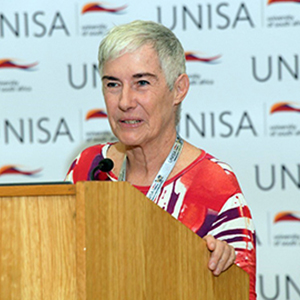
Prof Janet Cherry
Cherry spoke against violence as a societal challenge that must be addressed, recalling that women no longer walk freely at night. She explained: "South Africa is the third most violent country in the world, yet it is not at war." She also touched on obscene inequality, including a high unemployment rate and poor social mobility. "We are nine generations away from economic freedom," she noted. Regarding sustainable development, Cherry shared that South Africa produces more than enough food to cover its population, but poverty persists in the country.
Urging women to be courageous, Cherry remarked: "If women could mobilise to delegitimise apartheid practices, they can surely mobilise to hold the democratically elected government to account. It is better to act in support of an institution than to destroy it." She maintained that transformation means overcoming unacceptable inequality for a peaceful, equitable and sustainable future.
Cherry asserted that participating in development planning means ensuring that women’s needs are prioritised in every community. She concluded: "It means women have to be present in such engagements to voice those priorities."
#Unisa150
* By Nancy Legodi, Acting Senior Journalist, Department of Institutional Advancement
Publish date: 2023/08/22

 Unisa co-hosts G20 community outreach in the Eastern Cape
 Unisans gain membership of prestigious science academies
 Unisa alumna takes the helm at the SA Library for the Blind
 Advocating for disability transformation through servant leadership
 Unisa Press continues to illuminate the publishing space