News & Media
AI capitalism overshadows educational equality
On 06 November, Unisa’s Academic Development Open Virtual Hub (ADOVH) and the team from Reconfigurations of Educational In/Equality in a Digital World (RED) hosted a workshop to discuss the role of AI (artificial intelligence) in shaping inequality within education and broader society. This is part of a two-day open seminar and series of workshops by national and international experts themed Reconfigurations of Educational (In)equality in a Digital World, concluding on 07 November.
Click here to watch a recording of the proceedings.
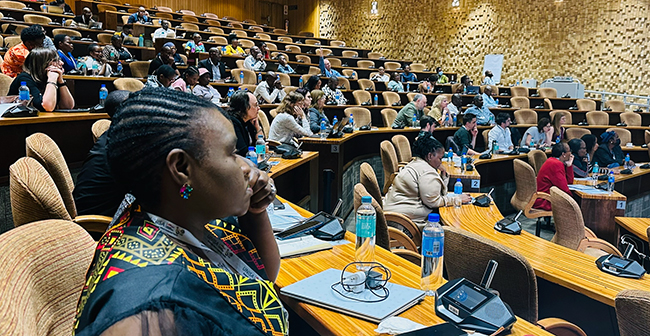
Workshop attendees
RED is an organisation with global partnerships, specialising in research projects that aim to address policies and practice challenges regarding digital education inequalities, and investigating how educational institutions’ data profiles are affected by digital inequalities.
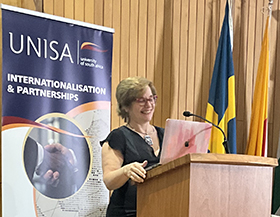
Prof Ines Dussel
In the first keynote address titled Rethinking educational (in)equalities in digitized schools: Policies and pedagogies in a changing world, Professor Ines Dussel of the Advanced Studies Center of the National Polytechnic Institute of Mexico, Cinvestav-IPN, stated that the COVID-19 pandemic brought a number of schools to a closure, and Mexico become one of the countries in which the pandemic lasted longer, with schools closed for about a year and half. “To ensure school continuity, schooling relied heavily on TV, radio and digital learning platforms” she explained.
“We did research on public schools, involving teachers, students, and families, to study the interactions between educational policies, technological infrastructures and pedagogical traditions and inequalities. One of the many findings was that public policies to alleviate educational inequalities focused mostly on access,” she stated.
Dussel explained that the Mexican state reacted quickly to the pandemic through launching a series of policies and their major programme was called the Aprende en Casa, which produced 175 television programmes a week for all school levels, and also broadcasts on radio and digital platforms. Most people did not have internet access, and therefore relied mainly on television and radio. “But what the state did not understand,” she said, “was that TV is now digital and expensive, with limited reach to rural areas. Against this background the state then signed an agreement with Google and Microsoft to create accounts that have access to Google Classroom. 50% of teachers and 30% of students signed up for Google Classroom – this shows the advance of private tech corporations into public education.”
“We still need to think about the long-term consequences that this will have,” she concluded.
How AI has infiltrated society and education
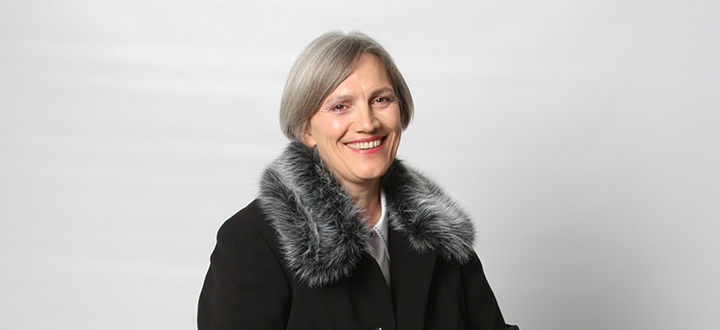
Prof Laura Czerniewicz
Professor Laura Czerniewicz, from Centre for Innovation in Learning and Teaching (CILT) at the University of Cape Town, presented the second keynote address titled AI and In/Justice. She stated that AI is not new in education and that it contributes immensely to this field. However, she cautioned that there are broader concerns. “In South Africa, inequality did not go away, and instead, was highlighted by COVID-19,” she stated, adding that this was more visible in the political economy, where the private sector dominates AI research. She explained: “You have a capitalist political economy that foregrounds profit-making, markets, growth, efficiency, and expansion. In the political economy of AI, investment is dominated by the private sector, globally and locally. Most models of AI are proprietary, and that is a huge issue. So much of the information I was able to find on this is US-centric, in the form of surveillance capitalism, which inserted itself into schools during COVID-19.”
Deep pockets
Czerniewicz stated that the most valuable companies in the world are in technology, and they have power and deep pockets. “These companies include Apple, Microsoft, Saudi Aramco and Alphabet,” said Czerniewicz, adding that they can afford massive marketisation, with a global investment in AI amounting to $340 billion.
She continued, “If you look at the United States, their key ingredients of AI research are computing power, large datasets and highly skilled researchers from the private sector.” She further said that a major concern is the low percentage of PhD students who opt to work in academia instead of the private sector.
“A report of AI in Africa,” said Czerniewicz, “found that four countries, South Africa, Nigeria, Egypt and Kenya, are the most active, and the majority of the activities are in the private sector, with profit-making setting the agenda. Open AI has become a misnomer because today it is no longer open and has been massively invested in by Microsoft. This lack of transparency means that what is happening is a serious black box, making it difficult for academics to study what is happening around big-tech developments.”
With regard to regulations, Czerniewicz found that South Africa and Mexico have easy data markets and unregulated exploratory spaces for big tech. She explained that educators do not have the opportunity to engage in the kinds of terms and conditions or the kinds of tools and apps brought in by big companies for their pedagogy.
In conclusion, Czerniewicz emphasised the reskilling of educators to work in tandem with the ever-evolving AI, and a relook at the regulatory measures towards big-tech companies. She also said that policies regarding digital learning tools must highlight teachers’ central role as an important aspect in the digitised classroom.
*By Godfrey Madibane, Acting Journalist, Department of Institutional Advancement
Publish date: 2023/11/09

 Unisa co-hosts G20 community outreach in the Eastern Cape
 Unisans gain membership of prestigious science academies
 Unisa alumna takes the helm at the SA Library for the Blind
 Advocating for disability transformation through servant leadership
 Unisa Press continues to illuminate the publishing space