News & Media
Analysing the impact of Covid-19 on the academe
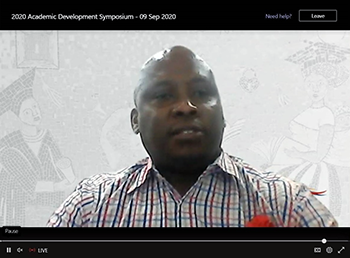
Mdu Ncongwane (Programme Director and Moderator: Sixth Annual Academic Development Symposium, Western Cape Region)
From 9 to 11 September 2020, the Unisa Western Cape Region convened, in virtual format, its sixth annual Academic Development symposium. The theme for 2020 was Education in South Africa during and post Covid-19: Reflections on the readiness and responsiveness of the sector to the inevitable changes in the post-schooling landscape.
More than 30 universities, post-school institutions, and corporate organisations attended the symposium. It explored the employment of new educational paradigms, especially in bringing teaching and learning online. The latter point was especially relevant, given the extent to which Covid-19 had forced academics and professional staff toward a sudden implementation of educational and tuition support platforms online.
In hosting its sixth annual academic development symposium, Unisa Western Cape created not only an opportune space for all stakeholders within post-school education and training to reflect on the strategies employed and their experiences during this unprecedented academic year, but also allowed them to share best and reflexive practices within the ambit of higher education teaching and learning. This symposium hosted more than 700 participants over the three days of the event.
In his opening address, Professor Steward Mothata, Unisa Registrar, asserted that it was admirable how the Western Cape Region of Unisa managed to create a space of engagement amid the Covid-19 pandemic, re-emphasising how innovation and the human mind and spirit can overcome all challenges during this difficult time.
Speakers for this year’s event included esteemed academics, higher education practitioners and post-schooling specialists consisting of Professor Narend Baijnath, Council for Higher Education; Professor Chris Winberg, Cape Peninsula University of Technology; Dr Keith Jacobs, Unisa; and Dr Kasturi Behari-Leak, University of Cape Town. Other speakers included Lunathi Hontoti, Nehawu, Unisa; Johan Jonker, APSA, Unisa; Professor Venicia McGhie, University of the Western Cape; Dr Nompilo Tshuma, Stellenbosch University; Luigia Nicholas, Stellenbosch University; Sisipho Saunders, Unisa; Akha Tutu, University of Cape Town; Adrienne van As, Two Oceans Institute; and Dr Zayd Waghid, Cape Peninsula University of Technology.
Serendipitously, and following on from the themes of the last two academic development symposia, it was evident that Covid-19 showed a different angle to challenges experienced by practitioners throughout the last few years. These challenges include encounters such as inequality, disinvestment, quality assurance, student access and success, and academic development. In addition, challenges in educational programmes or learning innovation were not spared. As much as practitioners pushed toward the integration of educational technologies and virtual learning to operate seamlessly, the well-balanced ratio between teaching and learning that the Fourth Industrial Revolution (4IR) promised did not live up to the teaching and learning and assessment promises that it advocated.
In its sixth year, the symposium shows that the impact that Covid-19 has on the academe has truly warranted closer connection, not only to explore learner support frameworks and quality assurance, but also to study its impact on the affective domain. With the focus on human agency and support during this pandemic, Baijnath skilfully emphasised how programmes and support models need to be integrated, considering what needs to be addressed, and focusing on what systems are workable, less burdensome, and impactful.
“What is important is that the connection between Covid-19 and learner support should focus on the pedagogies of care to students during the time of the pandemic and thereafter. This will send out a clear message of support to students, whilst finding new and meaningful ways to accommodate digital scholastic identities in the curricula as well,” were the reflective words of John Abrahams, Head of Facilitation of Learning at the Unisa Western Cape Campus.
With a high feedback success rating, the Academic Development symposium was held over a period of three days, commencing with conversations and presentations, followed by plenary sessions after each day.
*Submitted by Jacques du Toit, Academic Coordinator, Western Cape Region
Publish date: 2020/11/16

 Unisa co-hosts G20 community outreach in the Eastern Cape
 Unisans gain membership of prestigious science academies
 Unisa alumna takes the helm at the SA Library for the Blind
 Advocating for disability transformation through servant leadership
 Unisa Press continues to illuminate the publishing space