News & Media
Bolstering nutrition in African communities
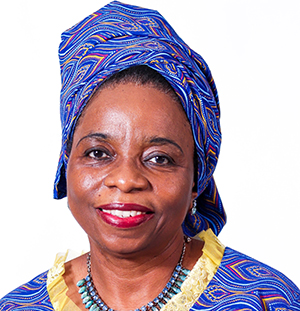 Prof Meahabo Magano, UWF Chairperson
On 30 May 2022, the Unisa Women’s Forum (UWF) and South African Women in Dialogue (SAWID) celebrated Africa Day under the theme The Year of Nutrition. The event was hosted virtually on Microsoft Teams.
The African Union (AU) declared 2022 as The Year of Nutrition to fight hunger and malnutrition in the continent. The main goal, according to the AU website, is to strengthen Africa’s resilience in nutrition and food security as part of the long-term vision set out in Agenda 2063.
UWF chairperson Professor Meahabo Magano said during her opening remarks, ‘The year of nutrition for us as women means a lot.’ She further explained that the UWF aligned the theme with that of the 2022 Nelson Mandela Day, Do what you can, with what you have, where you are.
Giving the keynote address, James King’ori from Nairobi, Kenya, provided an invaluable input and statistics around African nutritional status. He is the Senior Regional Nutrition Advisor for World Food Programme (WFP) Regional Bureau, based in Johannesburg, which supports a number of Southern African Development Community (SADC) countries. Though King’ori underscored issues concerning nutrition on the African continent, he also recognised the efforts that have been made to address malnutrition. Sharing his expertise as a nutritionist with over 20 years of field experience, King’ori discussed nutritional challenges in the continent, highlighting the increasing incidence of obesity, anaemia, low birth weight and noncommunicable diseases affecting mostly women.
In his presentation, King’ori noted the relationship between obesity and food systems. He pointed out that there are still data gaps that needs to be addressed to evaluate nutrition as a challenge in the regions and answer questions around processed and locally produces foods.
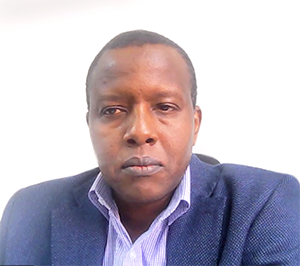
James King’ori gave the keynote address
Discussing nutritional vulnerabilities among African communities, King’ori emphasised the disparities in gender, with women being more disadvantaged. He posed two questions to the audience, ‘How do we help each other in the continent, and how do we improve socio-human capital development?’
King’ori said that women farmers are disadvantaged as they receive only one percent of financing. ‘If we invest in women the same way we invest in men, we can increase the percentage,’ he said. Moreover, said King’ori, education and vocational training is needed to engage in agriculture productivity and eradication of poverty among Africans. ‘We have good examples coming from regions such as Eswatini,’ he concluded. ‘’They are producing enough to eat and sell.’
Speaking at the event, Professor Puleng LenkaBula, the Principal and Vice-Chancellor (VC) of Unisa, acknowledged UWF members for always being inventive in building social cohesion and social capital, not only in the university but also in the communities where the university envisioned to service through education, research, engaged scholarship, and knowledge.
She added: ‘I would also want to acknowledge the UWF executive for prioritising the theme of food security and food sovereignty in the aftermath of COVID-19. That’s an area of challenge for our communities resulting from policy systems and regiments that are not attentive to sustainability, to the idea of environmental and ecological aspects intertwined with how we imagine ourselves and personhood particularly taking the adage that in African philosophy we are because of one another and also because of the cosmology, the environment and the ecological system.’
The VC made an appeal to the audience to stay committed. ‘We should invite in our hearts the commitment for rebuilding, reclaiming ourselves particularly as women in our communities around the contributions we have to make in the rebuilding of Africa, its people but also its ecological and future successes,’ she said.
‘African leaders were reaffirming to request that the African Union mandate should change in 2022 as the gains of economic freedom still needed to be improved and those ideals became clear in the agitation of the future being set out by societies,’ she continued. ‘The roles of women as partners in that mission of reigniting Africa’s prospects should include ensuring none of us is muted or silenced from participating in government systems of our countries and continent,’ she concluded.
Other speakers at the event included Dr Florence Malongane, Senior Lecturer in the College of Agriculture and Environmental Sciences, Dr Gladys Mokwena, a UWF member from the College of Education, and Lebo Mosime, a young woman farmer.
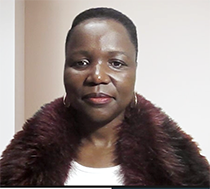 Dr Florence Malongane (CAES, UWF) |
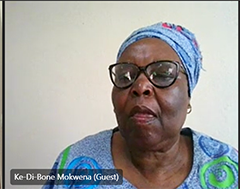 Dr Gladys Mokwena (CEDU) |
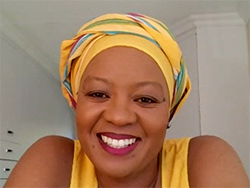 Lebo Mosime (Farmer) |
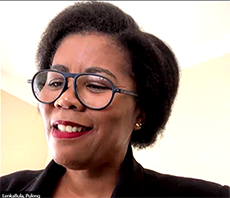 Prof Puleng LenkaBula, Unisa VC |
Malongane reiterated that 58,5% of our children experience stunted growth, while 4.1% are overweight and 11.4% have a low birth weight as a result of inadequate access to food and insufficient health services. Similarly, Mosime challenged the audience to start their own small gardens with what they have, offering practical advice in the process. Mokwena elaborated on food gardening as a way of strengthening resilience by way of natural nutrition. Mokwena shared the success story of a retired school principal who started food gardening to promote healthy eating at the Banareng Primary School in Atteridgeville. This food gardening project grew to the extent that parents, as well as the business sector became involved.
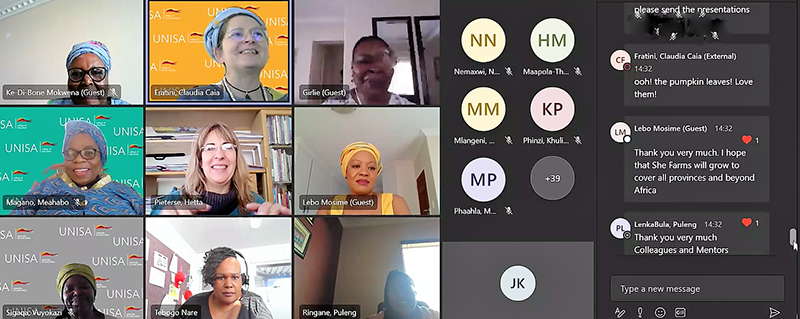
Attendees ululating in celebration of Africa Day
By way of high-pitched ululations, salutations and fascinating speeches, the event reinvigorated and reaffirmed women not only to gain economic freedom but also to take part and contribute to the building and flourishing of Africa.
*Compiled by the UWF Executive Committee with additional reporting by Lesego Chiloane-Ravhudzulo, Journalist, Department of Institutional Advancement
Publish date: 2022/06/06

 Unisa co-hosts G20 community outreach in the Eastern Cape
 Unisans gain membership of prestigious science academies
 Unisa alumna takes the helm at the SA Library for the Blind
 Advocating for disability transformation through servant leadership
 Unisa Press continues to illuminate the publishing space