News & Media
Celebrating women of stature
Graced by women of stature, Unisa virtually held the fifth Unisa-SAWID-UNWOMEN dialogue, themed Towards peace and gender equality: Collective legacies and co-creative solutions of African women, on 15 August 2021. The university celebrated the fallen heroines and appreciated those still among us, like Dr Phumzile Mlambo-Ngcuka, former South African Deputy President and former United Nations (UN) Women Executive Director and UN Under-Secretary-General, who was acknowledged as a leader who continues to positively uplift societies, especially women, across the globe.
As a university that embraces diversity, the prestigious event started and finished off with multi-faith devotions to ask for guidance from the Maker and the ancestors, as well as to thank them for leading the event.
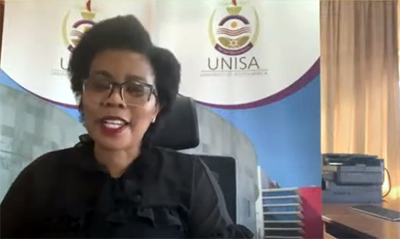
Prof Puleng LenkaBula (Principal and VC, Unisa)
As she warmly welcomed everyone, Professor Puleng LenkaBula, Principal and Vice-Chancellor of Unisa, said: “It is a day to celebrate fallen giants that mentored us. They are leading the global arena in ensuring that women’s talents, moral urgency, leadership, and the transformation of the world towards peace, justice, and economical and ecological flourishing, take place.” The VC lauded the leadership and bravery of Mlambo-Ngcuka in her path to change the world for the better.
She remarked: “Your work has been phenomenal, impactful, transformative and inspiring to all who wish to co-construct legacies of constructive present and the future.” LenkaBula appreciated that in the two decades of Mlambo-Ngcuka’s leadership in the UN, she ensured that women’s voices, participation, rights and talents are acknowledged by ensuring that she embraced examples that reminded society that gender equality is non-negotiable. “She also ensured that the agitation for the dignity, especially of gender non-conforming individuals, is not undermined by creating platforms that elevated their voices.”
Burning questions addressed
In an engagement moderated by Anne Githuku-Shongwe, UN Women Multi-Country Representative, Mlambo-Ngcuka responded to questions posed by Thoko Mpumlwana, Chair of the South African Women in Dialogue (SAWID) Trust, Mbali Njomane, social innovator, and the audience. Among others, the questions were around how women movements supported Mlambo-Ngcuka in her leadership at the UN and her advice to South Africans in ensuring that inter-generational dialogue, skills transfer, and mentorship are accessible.
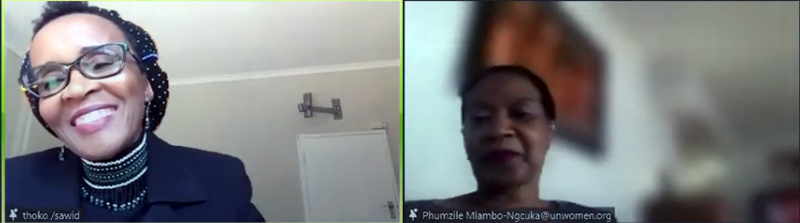
Thoko Mpumlwana (Chair: SAWID Trust) and Dr Phumzile Mlambo-Ngcuka (former SA Deputy President, UN Women Executive Director, and UN Under-Secretary-General)
As part of her response, Mlambo-Ngcuka remarked: “If it was not for the hard work by women and the movements across the world, the sustainability of the agenda for women would have been in trouble.” She encouraged for mentorship to also be done digitally in a case where mentors are busy, and to conduct master classes where issues that concern young women can be addressed. “Mentorship interaction is two-way; mentors and mentees can learn from each other and coming up with solutions can be a collective effort.”
Mlambo-Ngcuka reminded the audience that “you learn by observing, following and you discover some of your hidden talents. Mentorship allows mentors to demonstrate to the mentees that there are things that will not be learnt at schools. Do not get tired to ask questions as that allows you to dig deeper and find critical answers.”
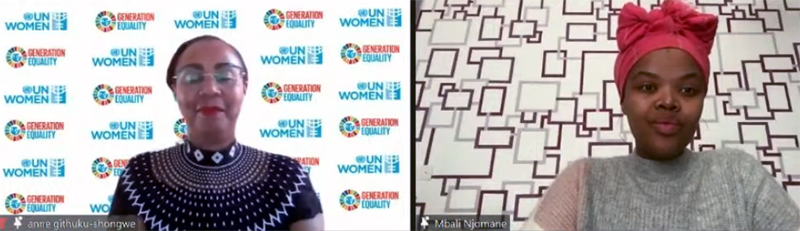
Anne Githuku-Shongwe (UN Women Multi-Country Representative) and Mbali Njomane (social innovator)
Safe travels back home
On behalf of Unisa, SAWID, and UN women, Mpumlwana delivered a farewell message to Mlambo-Ngcuka: “As a leader, you exceeded our expectations. While we were happy to have you go lead at UN Women, we were worried that our precious stone would be destroyed. However, the universe was calling you to use your tremendous energy, passion, creativity, and profound sense of justice for the greater good in the world—that is women in their diversity.”
Mpumlwana appreciated Mlambo-Ngcuka for occupying leadership positions that were not popular for women to occupy. “You have led the UN and created generation equality.” She further wished her safe travels back home as her term of office in the UN Women recently ended.
Women audiences proudly ululated throughout the event, while praise poet, Bishop Jessica Mbangeni and Unisa’s Claudia Fratini delivered moving tributes.
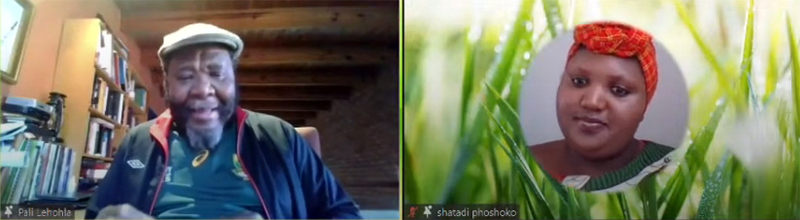
Prof Pali Lehohla (former South African Statistician-General) and Shatadi Phoshoko, (Secretary-General: Unisa SRC)
Enhancing the lives of women and children
Giving the background of the SAWID trans-disciplinary study on vulnerability and indigence assessment in South Africa: A civil society emergency response to Covid-19, which he and some experts from Unisa and other organisations were part of, Professor Pali Lehohla, former South African Statistician-General, spoke on how it focused on various women issues and the recommendations thereof.
Lehohla stated: “There are policy relevant issues that do not consider the unique circumstances that women have to face. If we think about #FeesMustFall, very little has been taken into account about the challenges that single mothers face.” He added that if we had an accountable society and government, we would not be where we are today. Some of the recommendations that Lehohla mentioned were the creation and implementation of accountability systems and involving women in policy making decisions.
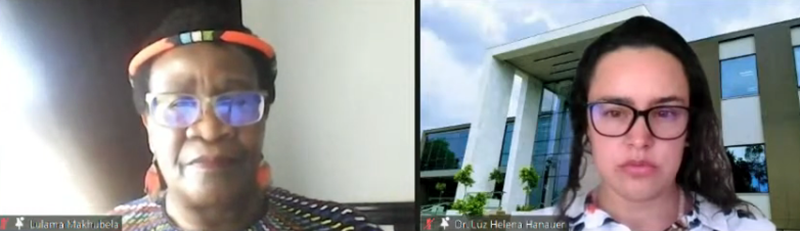
Prof Lulama Makhubela (Deputy Vice Chancellor: Postgraduate Studies, Research & Innovation, TUT) and Dr Luz Helena Hanauer (ED: WDB Trust)
Dr Luz Helena Hanauer, Executive Director of the WDB Trust, showcased a case study that demonstrates how possible it is to change the plight of the vulnerable and the indigent in South Africa. Shatadi Phoshoko, Secretary-General of Unisa National Student Representative Council, articulated the voice of the youth within the context of the discussion.
Other sessions and engagements focused on Embedding the SA National Action Plan on Women; Peace and security; Beauty of the heart: The legacy and contribution of Charlotte Maxeke; showcasing books by African and South African women writers; and Intersectional Inclusion: “Exclusion cannot continue to be the norm”.
Dr Criselda Kananda, SAWID trustee, thanked all women and stakeholders who made the event possible, and encouraged women to be agents of their own development.
*By Nancy Legodi, Acting Journalist, Department of Institutional Advancement
Publish date: 2021/08/21

 Unisa co-hosts G20 community outreach in the Eastern Cape
 Unisans gain membership of prestigious science academies
 Unisa alumna takes the helm at the SA Library for the Blind
 Advocating for disability transformation through servant leadership
 Unisa Press continues to illuminate the publishing space