News & Media
Diplomatic engagement strengthening Unisa’s global footprint
Unisa hosted another successful Vice-Chancellor engagement with International Missions on 21 October 2020. This engagement was the third event following those in 2018 and 2019.
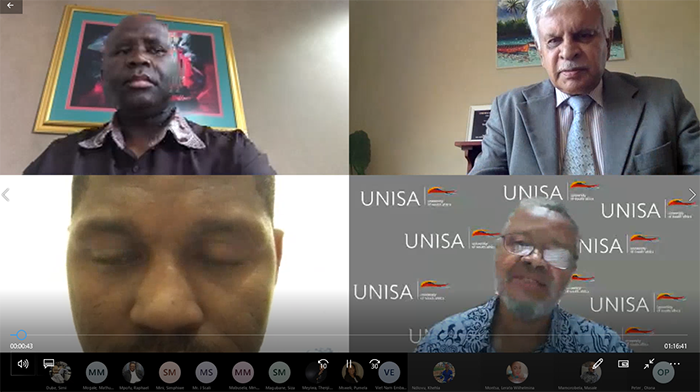
In 2018, the theme was Diplomats Advancing Higher Education (HE) in the Mandela/Sisulu Centenary, while the 2019 focus was on the Advancement of South-South Cooperation and Sustainable Development and Training
The 2020 event was held under the theme of The role of universities in advancing collaboration, regional integration, and development, post the Covid-19 pandemic. Organised by the Strategic Partnerships Division in the Institutional Advancement Department, the virtual event was exciting, streaming through MS Teams and attended by the university’s extended management and esteemed members of the diplomatic corps from various countries, including Mauritius, Singapore, Namibia, and Vietnam.
In his opening remarks, Professor Mandla Makhanya, the outgoing Principal and Vice-Chancellor of Unisa, touched on the mental health of people globally in pursuit of the survival of disrupted lifestyles due to Covid-19. He said some built resilience and used it as an opportunity to pursue other interests whereas others found themselves having to deal with challenges such as such as divorces, suicide, depression, growing gender-based violence, and disrupted lifestyles.
The VC highlighted milestones reached by South Africa in advancing regional integration and development, including the recent assumption of the role of Chairperson of the African Union by the country’s President Cyril Ramaphosa, the magnitude of Unisa and its national and international footprint in influencing the African and global agenda, and the recent launch of the Thabo Mbeki African Public and International School.
In view of the challenges brought by Covid-19, Makhanya said SA needed to advance collaborations with other African countries to address regional challenges and promote accelerated entry into the world of the Fourth Industrial Revolution (4IR). “This is possible through curriculum development, offering short learning programmes, research partnerships, and other related activities,” he added. “You have to be in it to win it; this applies to challenges that our continent should overcome.”
The discussions were brief but insightful as facilitated by the well-informed chairperson, Dr Somadoda Fikeni, Director of VC Projects and Advisor to the Principal. Even though the event was virtual, the chairperson opened the discussion to involve various stakeholders. Professor Raphael Mpofu, Deputy Executive Dean of the College of Economic and Management Sciences, highlighted the university’s collaboration with the African Union (AU)—a strategic collaboration since 2014—aimed at assisting with research proposals and projects that can advance the implementation of Agenda 2063 and meant to cover six regions of Africa, including the diaspora.
Professor Thenjiwe Meyiwa, Vice-Principal of Research, Postgraduate Studies, Innovation, and Commercialisation, raised a concern about the ongoing protests and the deaths of Nigerians, suggesting Unisa should also take a strong outlook towards the ongoing impasse between the people and the Government of Nigeria considering the African Union 2020 theme of ‘Silencing the Guns’ to advance harmony, human rights, and prevent violent conflict in Africa.
The High Commissioner for Mauritius, HE Ambassador Vijaye Lutchmun, remarked briefly about the work done to control and manage the oil spill in his country and their remarkable control of Covid-19 infections, indicating that there are no new cases of the coronavirus unless those have now come from visitors touring his country. He expressed an interest in advancing collaboration between Unisa and Mauritian universities, indicating that they have various English and French institutions of higher education.
Following these stimulating engagements, Professor Khehla Ndlovu, Vice-Principal of Strategy, Risk, and Advisory Services, closed the event by emphasising that Unisa has wide footprints in Africa and beyond. He highlighted that the university is in collaboration with Eritrea and that Covid-19 impacted on its plans to visit the region. Eritrea has 54 students doing their master’s degrees with Unisa, supported by the United Nations Development Programme (UNDP). He thanked everyone involved in organising the event and, in particular, the VC, since this had been his last diplomatic event to host as head of the institution.
*By Khomotso Mabusela Collaborations Officer, Strategic Partnerships, with initial edit by Lesego Ravhudzulo, Journalist, Department of Institutional Advancement
Teaser image sourced under a Creative Commons licence from Alvin Lee.
Publish date: 2020/11/11

 Unisa co-hosts G20 community outreach in the Eastern Cape
 Unisans gain membership of prestigious science academies
 Unisa alumna takes the helm at the SA Library for the Blind
 Advocating for disability transformation through servant leadership
 Unisa Press continues to illuminate the publishing space