News & Media
Discourses on black women leadership in the South African academy
Organised by Unisa’s Department of Leadership and Transformation (DLT) under the Principal and Vice-Chancellor’s Office, a Women’s Day Seminar took place on 7 August 2024 at the Bamboo Auditorium, Kgorong Building.
The theme of the seminar was Sexist/Racist discourses on leadership of black women in the South African academy.
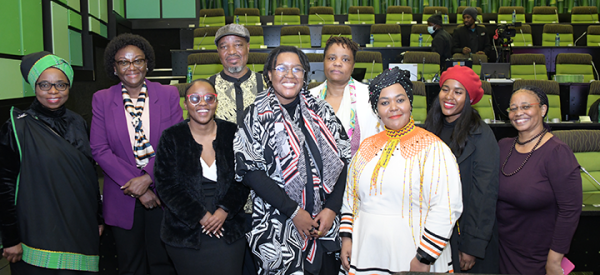
Front, from left: Kgothatso Mosimege (Sports and Culture Officer: National Student Representative Council), Siphokazi Tau (African Feminist Researcher: University of Johannesburg), Prof Sindile Ngubane (Chair: Unisa Institute for Open Distance Learning)
Back, from left: Prof Meahabo Magano (Executive Director: Department of Tuition Support and Facilitation of Learning), Prof Rhoda Wanyenze (Dean: Makerere University’s School of Public Health), Dr Malekutu Bopape (Acting Executive Director: Department of Leadership and Transformation), Prof Grace Khunou (Director: Scholarship Change), Lesego Plank (Researcher: Chief Albert Luthuli Research Chair) and Dr Kelebogile Choice Makhetha (Senior Director: Stellenbosch University’s Division for Student Affairs)
The seminar placed the spotlight on racism and sexism in the South African higher education landscape, focusing on the low numbers of women in leadership positions and specifically the low numbers of black women in such leadership positions. Hence, all speakers presented on the appointment of black women in senior academic leadership positions.
In his welcoming and opening remarks, Dr Malekutu Bopape, Acting Executive Director of the DLT, explained the existence of transformation at Unisa and gave reasons why Unisans should comply with the South African Constitution and other appropriate legislation.
Speaking on transformation being located in the Office of the Principal and Vice-Chancellor, Bopape said it was for legitimacy and power purposes. He said that although this location might be symbolic, it was still substantive. Bopape further indicated that transformation was a project that had to be undertaken by the leadership of the university.
According to Prof Grace Khunou, Director of Scholarship Change in the DLT, "there are challenges not only in the top leadership of universities, but also in intellectual spaces". She said that black women are seldom found in leading and chairing positions in research centres around the country.
Furthermore, Khunou said "black women are getting more PhDs, but it does not translate into them being considered in leadership positions in the academy – thirty years after democracy we need to see a change".
Prof Meahabo Magano, Executive Director of the Department of Tuition Support and Facilitation of Learning (DTSFL) in the College of Education (CEDU), also echoed the importance and significance of commemorating women in the academic space in her presentation entitled Are women leading?.
Magano extracted statistics during her presentation, indicating that three of the six current South African female vice-chancellors are serving their second term and three are in their first terms. She articulated the challenges of female vice-chancellors not finishing their term of office.
Dr Kelebogile Choice Makhetha, Senior Director of the Division for Student Affairs at Stellenbosch University, shared with the audience in her panellist address the harsh realities of racism and sexism in universities. She spoke of incidences of white supremacy which were cruel for young academics at the time she was a beginner in her academic career.
Meanwhile, Prof Sindile Ngubane, Chair of the Institute for Open Distance Learning in CEDU, elaborated on the voices of women in the academic environment. Her presentation entitled Transformational leadership and inclusion explained the challenges women in leadership roles face in universities. She said black women leaders are portrayed as angry and overly aggressive. "Black women have historically been subjected to hypersexualisation, which affects how they are perceived and treated in professional environments," she said.
In her reflections on transformational leadership and inclusion, Ngubane emphasised that it was critical for the South African academy to ensure that leadership opportunities are accessible to all, regardless of their diverse needs and backgrounds. She believes that it is important to address and respond to diversity by increasing participation in all aspects of culture and community to reduce exclusion.
Siphokazi Tau, an African Feminist Researcher at the University of Johannesburg (UJ), spoke at length about her lived experiences of being an African woman and a feminist. In addition, Kgothatso Mosimege, Sports and Culture Officer of the National Student Representative Council (NSRC), reflected on challenges young women face in student organisations.
Moreover, Prof Rhoda Wanyenze, Dean of the School of Public Health from Makerere University in Uganda, presented on gender equality and women’s participation in university leadership in East Africa. "Gender inequality in university leadership persists despite previous interventions across universities in Africa," said Wanyenze. She also elaborated on women’s lack of progression in academic and research careers which is shaped by intersections between gender roles and social power relations of gender within the family, wider society and academic institutions.
Towards the end of a very successful seminar, Lesego Plank, a Researcher at Unisa’s Chief Albert Luthuli Research Chair, recited a poem honouring women in academia and identifying issues they face daily.
Watch a recording of the event
* By Lesego Chiloane, Marketing and Communication Specialist (acting), Unisa Department of Leadership and Transformation
Publish date: 2024/08/21

 Unisa co-hosts G20 community outreach in the Eastern Cape
 Unisans gain membership of prestigious science academies
 Unisa alumna takes the helm at the SA Library for the Blind
 Advocating for disability transformation through servant leadership
 Unisa Press continues to illuminate the publishing space