News & Media
‘Education must be revolutionary and transformative’
Universities South Africa in partnership with the Council on Higher Education are hosting the 2nd Higher Education Conference from 6-8 October 2021 under the theme The Engaged University. On 6 October, Unisa Principal and Vice-Chancellor (VC), Professor Puleng LenkaBula, addressed the session in her capacity as the Chairperson of the Transformation Strategy Group on the sub-theme The Engaged University and Transformation.
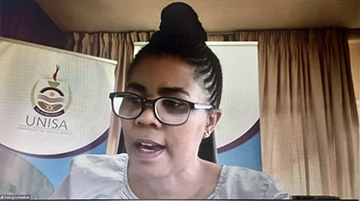
Prof. Puleng LenkaBula, Unisa Principal and Vice-Chancellor
The key focus of deliberations in this group was on its 2021 priorities, which include the reconstruction of institutional culture by focusing on the design of universities around students and staff, with emphasis on residences and the curriculum, and addressing inequalities highlighted by COVID-19. The theme of the conference aims to, among others, encourage and support solution-building among key stakeholders through facilitated dialogue and enquiry, and identify a set of goals and concrete actions towards the advancement and achievement of the engaged university.
The VC began by acknowledging that the higher education sector is at the crossroads with universities facing unprecedented pressures on multiple fronts, including issues around finance and funding of higher education. She suggested: “For us to question the notion of engaged scholarship or engaged universities, we must first ask what the value or validity of the higher education system is and if it is enabling for students, staff and those in the pursuit of knowledge.”
The VC encouraged universities to question how they deal with issues of gender and inclusion of students with disabilities and LGBTQIA+ communities, asking “[a]re they embraced and see themselves in the curricular that they are learning from, or do they see themselves as aliens in the knowledge arena?”
The articulation of higher education
The VC also spoke on the context within which the articulation of higher education takes place. She reiterated the context of digitalisation and of South Africa and its geo-spatial political and economic location as a consumer of digital systems, and not necessarily the owner. She asked: “Is an engaged university in the forefront of constructing knowledge or co-constructing and inventing knowledge, which is shared, developed and optimised in the multiplicities of sectors within society? Or is it entwined with the digitalisation systems that it has to buy, which it has no control of in the teaching and learning processes, therefore, how do we transform such?”
Speaking on the overwhelming commodifying and disruptive thrust of the digitalisation system, the VC said: “It is clear that universities need to be more engaged than ever, and that new transformations seem to be at the centre of the commodification of knowledge, including the dependency on the institutional and information and communications technology infrastructure that are not necessarily available for the Global South.”
Referring to publications by some renowned scholars around the commoditisation and transformation of the higher education system, the VC remarked that there is a need to pay attention to them in the post-COVID-19 context for engaged scholarship and transformation to manifest. Further to the reference, she asserted: “Education must be revolutionary, transformative, and enabling for the urgency of participants to co-construct the future as moral agents in the planning arena.”
Understanding the colonial throttle over the knowledge systems
According to the VC, discussions around engaged universities and engaged scholarship need a thorough understanding of the colonial throttle over the knowledge systems within the context of African universities or post-school education system.
The VC referred to specific scholars around decolonial scholarship, and stated: “In the post-colonial discourse, the idea is never to be rendered marginal. We need to claim voice, participation and co-construction of knowledges, innovations, inventions, civilisations and ideas that promote dignity and are humanising. These ideas must ensure that knowledge is not limited to just a few, and that knowledge systems produced by universities are relevant for the knowledge economy and for transforming societies.”
In conclusion, the VC remarked: “Engaged scholarship and engaged universities will not exist if they do not enable and facilitate the pursuit of wisdom, and for humanising dignified and inventive environments that allow people to come as they are. People must be allowed to contribute to the knowledge systems and knowledge arena in the contextual environments within which they exist, whilst aspiring for their knowledge systems to find a global footprint.”
*By Nancy Legodi, Acting Journalist, Department of Institutional Advancement
Publish date: 2021/10/08


 Unisa co-hosts G20 community outreach in the Eastern Cape
 Unisans gain membership of prestigious science academies
 Unisa alumna takes the helm at the SA Library for the Blind
 Advocating for disability transformation through servant leadership
 Unisa Press continues to illuminate the publishing space