News & Media
First HESCoP AGM a triumph for Unisa
The Unisa Sustainability Office started engaging with Higher Education South Africa (HESA), now Universities South Africa (USAf), in 2015 with a view to establishing a community of practice for sustainability under the auspices of HESA. This foresight paid off when the USAf Board approved the establishment of the Higher Education Sustainability Community for Practice (HESCoP) in June 2022.
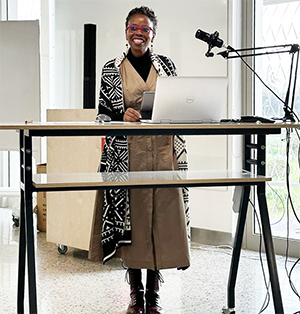
Prof Elelwani Ramugondo, Deputy Vice-Chancellor for Transformation, Student Affairs and Social Responsiveness, University of Cape Town
The Unisa Sustainability Office then took responsibility for arranging the first HESCoP Annual General Meeting at the Hasso Plattner School of Design Thinking Afrika (d-school Afrika) at the University of Cape Town (UCT) on 12 April 2023. This hybrid event, where the first HESCoP officials were also elected, bore evidence that sustainability issues in higher education are slowly gaining momentum.
It was evident that all universities are at different stages of their sustainability journey, but as the commitment to this matter is of equal importance to all institutions, it is quite beneficial for members of this community of practice to share their journeys. The aim of HESCoP is to develop and contribute to policy positions on environmental sustainability matters in higher education to strengthen teaching and learning, research, community engagement and operational activities relating to sustainability at universities nationally and internationally.
UCT’s Deputy Vice-Chancellor for Transformation, Student Affairs and Social Responsiveness, Prof Elelwani Ramugondo, welcomed delegates who attended online and in person. Ramugondo reminded attendees that HESCoP is an excellent example of how universities can share lessons learned, good practice, useful benchmarks and conceptual frameworks to guide South African universities on how to become more sustainable and work together to grow and contribute towards achieving the 17 Sustainable Development Goals (SDGs) set by the United Nations (UN).
Chief Mabizela, Director: Operations and Sector Support at USAf, reiterated that HESCoP does not exist in isolation and that USAf regards sustainability matters as extremely important to the higher education sector. This position was elaborated on further by the University of Pretoria's (UP's) Prof Tawana Kupe, chair of the USAf Funding Strategy Group that HESCoP reports into.
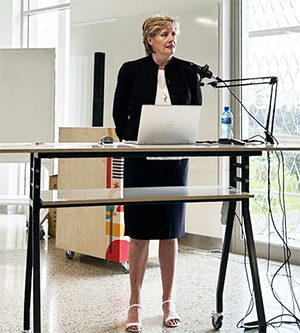
Programme Director, Dr Thelma Louw, Director: Sustainability, Monitoring and Evaluation, Department: Quality Assurance and Enhancement, Unisa
One important and unique element of the HESCoP annual meeting was to allow universities to share their sustainability journeys and to learn from one another. Indeed, presentations from different delegates showed just that. Dr Yolande Steenkamp from UP highlighted the importance of the SDGs in higher education and the role universities can play to achieve these goals. John De Wet from Stellenbosch University presented on that university’s progress on their sustainability initiatives and their vision towards being a net zero carbon institution in 2050. UCT’s Manfred Braune showcased their journey in green campus development and Dr Andrew Tucker explored the role the African Centre for Cities is playing towards a just urban transition to sustainability in Africa and South Africa.
To underline the fact that sustainability is about more than trees and buildings, Dr Lazarus Chapungu, a researcher from the EXXARO Chair in Business and Climate Change at Unisa, presented the preliminary results of their study into the impact of Covid-19 on socio-economic (livelihoods) development in the Limpopo Province, South Africa.
The meeting dealt with a few hard issues as well. In 2008, the Minister of Mineral Resources and Energy promulgated the Regulations for Mandatory Display and Submission of Energy Performance Certificates (EPC) for Buildings with a net floor area of 2000 m2 or more. These regulations require building owners, including institutions of higher education, to display each building’s EPC at the entrance to that building. Nqobile Ngcobo from South African National Energy Development Institute (SANEDI), the structure responsible for maintaining, operating and managing the National Building Energy Performance Register (NBEPR), provided invaluable information on energy performance certificates, the EPC registration process and the consequences of non-compliance.
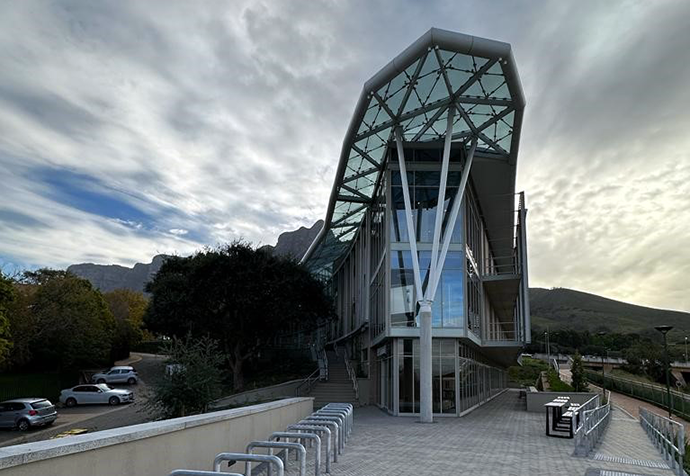
The d-school Afrika building
As institutions of higher education also need to start reporting their carbon emissions, Rumbidzai Mhunduru, a greenhouse gases (GHG) Inventory Specialist from the Department of Environment, Forestry and Fisheries, guided the delegates through the what and how of reporting their university’s greenhouse gas emissions on the South African Greenhouse Gas Emissions Reporting System (SAGERS) portal.
Before the breakaway sessions of the HESCoP subcommittees and the announcement of the election results, Dr Debra Rowe, President of the US Partnership for Education for Sustainable Development at Green Jobs (YALE University), gave a thought-inspiring talk on the National Clean Energy Workforce. She highlighted the importance of meeting the needs of the present generation without compromising the ability of future generations to meet their needs, through education and a just energy transition. She was adamant that it can only be done by creating buy-in and accelerating change.
To Unisans the final highlight of a very successful event was that Dr Thelma Louw, Director: Sustainability, Monitoring and Evaluation in the Department: Quality Assurance and Enhancement, was elected as Chairperson of HESCoP. Manfred Braune from UCT was elected as Vice-Chairperson.
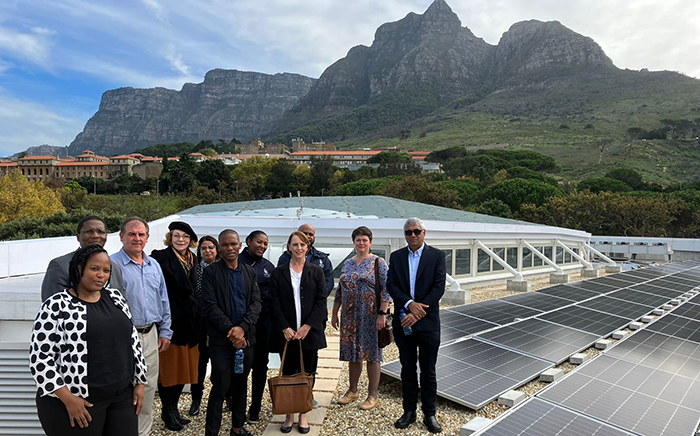
Delegates inspecting solar panels on the roof of the d-school Afrika building
The HESCoP webpage can be accessed at https://www.usaf.ac.za/higher-education-sustainability-community-of-practice/
* Submitted by the Directorate: Sustainability, Monitoring and Evaluation, Department of Quality Assurance and Enhancement
Publish date: 2023/04/24


 Unisa co-hosts G20 community outreach in the Eastern Cape
 Unisans gain membership of prestigious science academies
 Unisa alumna takes the helm at the SA Library for the Blind
 Advocating for disability transformation through servant leadership
 Unisa Press continues to illuminate the publishing space