News & Media
I will forever be a part of Unisa
On 4 December 2020, Unisa conferred the degree of Doctor of Philosophy (honoris causa) on Professor Molefi Kete Asante, recognising his immense productivity in the interest of Africa and humanity.
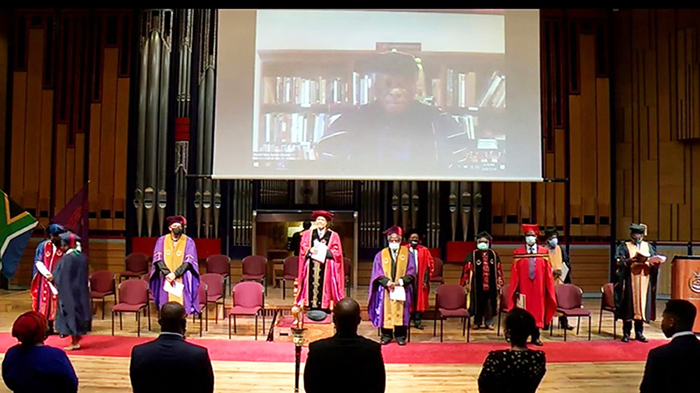
The Chair of Department of Africology and African American Studies at Temple University, Philadelphia, USA, sees himself in the light of his African roots as a descendant of the Yoruba and Nubian people enslaved in the Americas. Akan traditional kingship was conferred on Asante, and he received titles from the Songhay of Mali and the Igbo of Nigeria.
He is recognised as a true son of Africa by the Zulu, Peul, Wolof, Xhosa and Bamileke, hence Asante regards himself as a Pan-African Afrocentrist. His belief is that nothing is more important than the continent’s own traditions as the basis for raising children. Also, he is of the opinion that he exists only because his African ancestors existed.
Asante’s honorary degree from Unisa is his fourth. He has other three honorary degrees already to his name for his role as an activist-scholar and for his community and educational work.
Just moments before he was granted the coveted degree virtually due to Covid-19 travelling restrictions, Asante displayed his celebratory spirit by giving a bow on the screen to show his gratitude and respect to the university.
In his acceptance speech, Asante began by thanking his ancestors. He said: "Today you have honoured me with a recognition greater than any that I have ever received. It is true that I have a few honorary degrees but none so consequential as this one."
Asante further said that he has been honoured by academics from Mexico, Russia, Nigeria, Brazil, Ghana, USA, Portugal, China and Japan, among many other states. However, he stated that there is no other university or institution which had fully sensed the significance of his work in Afrocentricity as Unisa. "I am a particular fan of this university," he affirmed.
"My aim has been to introduce a new paradigm where all questions first have an African interrogation: what did our ancestors say about this or that? What conclusions did they make? How can I interpret their understandings from their behaviours?"
Asante’s acceptance speech embraced his identity as an African scholar and descendant. "Life has taught me that the art of understanding starts with curiosity; that is why I am also taught of the achievements of our ancestors whose words, deeds and ideas were distorted, stolen, and often misunderstood and misguided. Africans were the first scientists."
According to Asante, these African men and women studied the stars, planets, forests and mountains. "They knew the characteristics of animals. They shared knowledge with each other, and understood the cosmos, the quality of the soil, and the impact on humans and agriculture," he said.
Cited for his work in founding the first PhD programme in African-American studies, Asante’s work on race and culture in American society continues to be recognised globally. He has 92 books to his name, over 500 articles and the direction of more than 140 doctoral students. Generally, he is recognised as one of the most influential and widely revered African scholars.
Concluding his speech, Asante said: "I humbly accept your recognition of my award as ultimately freeing our minds from all forms of oppression, patriotism, gender discrimination, abusive hegemony, and I will forever be a part of Unisa. Thank you so much for this wonderful honour you bestowed upon me today."
* By Lesego Ravhudzulo, Journalist, Department of Institutional Advancement
Publish date: 2020/12/10


 Unisa co-hosts G20 community outreach in the Eastern Cape
 Unisans gain membership of prestigious science academies
 Unisa alumna takes the helm at the SA Library for the Blind
 Advocating for disability transformation through servant leadership
 Unisa Press continues to illuminate the publishing space