News & Media
Joining hands in peace for the future of education
From 6 to 9 November 2023, more than 600 open distance learning (ODL) scholars from over 60 countries across the globe descended on the tiny Caribbean country of Costa Rica to attend the 29th ICDE World Conference. The International Council for Open and Distance Education (ICDE) conference is widely recognised as the leading international event for open, flexible and distance education, and typically attracts around 1,000 participants worldwide. The world conference offers a forum for presenting cutting-edge developments and a platform to directly impact and contribute to future international, regional and national educational policy discussions.
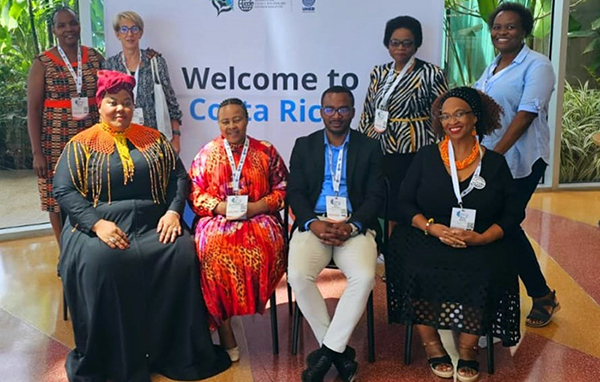
Open distance learning scholars at the 29th International Council for Open and Distance Education Conference
This year's conference theme was Joining hands in peace for the future of education. The event showcased presentations ranging from student-centred approaches, accessibility to platforms, relevant and responsive knowledge, and innovative ways of teaching and learning in the highly digital era. The Unisa delegation pulled crowds in with unique presentation subjects, ranging from artificial intelligence (AI) in teacher education, student support, resilience among students with disabilities, and food insecurity among ODL students.
The conference was an excellent experience for both the seasoned and budding scholars. High-level ideas on open, flexible distance education typified the event. It also allowed doctoral students to present their studies to their peers and academics. The ICDE Global Doctoral Consortium is a legacy project that started at Unisa in 2015 when the university hosted the ICDE. The programme was the ICDE conference's highlight, shaping future academic leaders and scholars.
One of the conference's most significant highlights was a forum which gathered leaders in the field of ODL to discuss its future trajectory. The meeting provided a unique opportunity to explore emerging trends, challenges and opportunities in distance education. The discussions revolved around the potential of technology, pedagogical advancements and learner-centred approaches to shape the future of ODL. Leaders in open and distance education institutions examined the key elements of the "value proposition" of open education and how they align with the students' needs, potential employers, government entities and academia. The exercise yielded thought-provoking ideas on how distance and open education leaders should strategically position the field amidst competing priorities, what structural changes are needed to support flexible, open and personalised learning in a highly digitalised world, and how to manage the transition.
Presenters demonstrated a deep understanding of ODL by offering valuable insights and thought-provoking ideas while addressing several topical issues. Keynote addresses ranged from strategy, policies and practice. In a study conducted by Educause, Joe O'Brien found that digital transformation is a high and critical priority in education. Additionally, the study suggests that concerted efforts should be made to address mental health issues that affect students and academics in higher education.
O'Brien pointed out a salient factor throughout the keynote address. He asserted: "No institution can be successful and sustainable without placing students' success at the centre." He gave examples of some institutions that use chatbots to answer student questions, chatbots or pop-up messages that remind students of deadlines, apps that include student services, and virtual appointment scheduling.
Some keynote addresses highlighted AI issues that have permeated every aspect of education. Prof Albert Sangra from the Open University of Catalonia argued that AI will play a more than relevant role in the future. "Technology is not the enemy; it is the ally for learning and for the practice of complex and costly competencies as long as we make it equitable," he said.
In his keynote address, Dr Tony Mays explored how the Covid-19 pandemic disrupted the traditional way of doing things in teaching and learning. "The use of technology and innovation has heightened, and distance education has become valuable, with its character trait of flexibility, inclusivity and access to all," said Mays. He further argued: "Continuous professional development is needed for online teaching, student support and improved pass and throughput rates."
The four-day conference ended by acknowledging the contributions of scholars in the field. Prof Don Olcott, a professor extraordinaire in the Unisa's Institute for Open Distance Learning, was awarded the 2023 Prize of Excellence for lifelong contribution to the field. Prof Mpine Makoe was elected to the ICDE Board.
#Unisa150
* By the Department of Institutional Advancement
Publish date: 2023/11/14


 Unisa co-hosts G20 community outreach in the Eastern Cape
 Unisans gain membership of prestigious science academies
 Unisa alumna takes the helm at the SA Library for the Blind
 Advocating for disability transformation through servant leadership
 Unisa Press continues to illuminate the publishing space