News & Media
Lecturer transitions to institutional research for broader and faster impact
"It is all about impact and making a change in society; that is why I did not become a clinical psychologist but a researcher; instead, I wanted to have a broader impact. Do not get me wrong; I am not deriding clinical psychologists. We need them. But I wanted a broader and faster impact than just one person at a time."
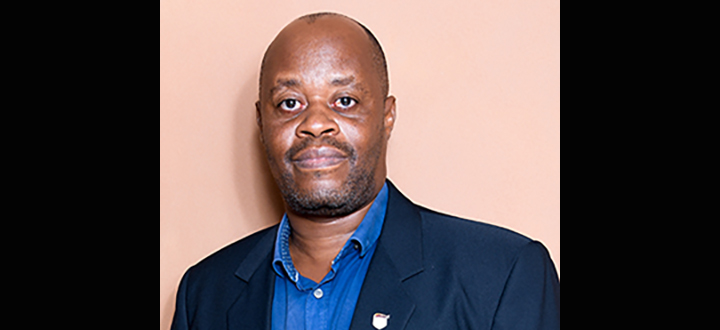
These are the sentiments of Dr Angelo Fynn, a Specialist Institutional Researcher in the Directorate of Institutional Research. His research in education psychology, student success and learning analytics has improved Unisa students' performance, support, risk management and health (behaviour and mental processes).
"I research into these areas so that I can inform management and academics about the issues that students are facing so that it can be taken into consideration when they make their decisions," says Fynn.
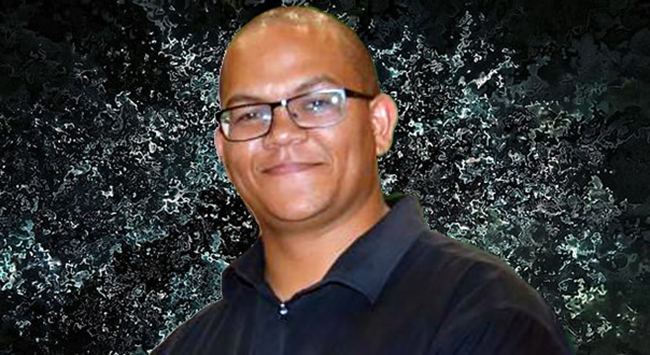
Dr Angelo Fynn
Understanding challenges and perseverance of studying through distance education
Fynn explains that his lived experiences as a student shaped his career path. "I have studied all my degrees through Unisa. I had to work throughout all my studies. I did not have the privilege of attending a contact institution, so I understand the difficulties, challenges and the perseverance it takes to study through distance education," he reflects.
He did his BA Honours in Psychology (2007–2008), Master of Arts Psychology with Specialisation in Research Consultation (2009–2012) and Doctor of Philosophy in Psychology (2013–2015).
Fynn has been on both sides of the Unisa coin as a student and staff member. Between his studies, he has worked as a Research Intern, Lecturer and Senior Lecturer in the Department of Psychology, Manager in the Student Success Unit, and now as a Specialist Institutional Researcher. In addition, he has served as the Chairperson of the Research Ethics Working Group for the Professional Research Committee.
"I see all the different ways people put effort into making a success for each student. But I also see how we are not getting it right," says Fynn. Nevertheless, he hopes that the institutional research they are doing will go a long way to alleviating the issues that students are facing.
"I also hope that by making the situation better for Unisa students, we are also helping society by improving the quality of graduates that we are putting out because Unisa is the biggest supplier of professional labour in the country," he adds.
Student-centric solutions implemented
One of the significant recommendations (solutions) that came out of his research while working in the Student Success Unit was the establishment of the Student Retention Unit (SRU), where they run the first-year experience (FYE) for students.
"The FYE is a university initiative geared towards integrating and streamlining the broad range of support services to ensure timely and relevant support is available to Unisa first-year students."
Students used to come into the Open Distance e-Learning (ODeL) system "blind" (unknowingly). Now, colleagues in the SRU are orienting students and guiding them through their first-year journey. They take students by hand and show them how the system works.
Another research recommendation that has been implemented is to help track students stuck in the system (repeating modules multiple times and not progressing in their degrees) to get them support. Equally important is identifying students in continuous assessment modules who are falling behind. "That is just the small things that make a big difference for individuals," he says.
Examining staff burnout
"Covid-19 generated the need for changes in the higher education sector, sparking a shift to online approaches and ultimately increasing the workload."
In early 2022, Fynn and his colleague, Hugo van der Walt, conducted a study examining Unisa's mental health and burnout to see how staff cope.
Fynn says these factors fit into the broad student success way of thinking because it is a systematic way of looking at the university and students and how they interact.
"This study assessed the prevalence of burnout symptoms among academics at Unisa. The research paper highlights the impact of teaching transitions on the academic workforce within South Africa, contributing towards wellness interventions aiding the recovery from burnout."
Open-access publications to inform the academic society
As an institutional researcher, Fynn has produced more reports than articles. He also publishes journal articles on student success and teaching and learning. In addition, he has published 19 journal articles and one book, Transforming Research Methods in the Social Sciences: Case Studies from South Africa. Students can freely access and download these open-access resources.
The book is a research methods textbook focusing on research and how to use such methods in South Africa. "We set out with the idea of making the book free because your typical research textbook costs between R800 and R1 000," he said.
Looking back to the research projects that he has worked on and solutions that have been implemented, Fynn says: "It is always nice to see that your hard work did not just go and sit on somebody's desktop somewhere, that it moved them enough to take action and do something about it."
* By Mpho Moloele, PR and Communications, Department of Research, Innovation & Commercialisation
Publish date: 2023/04/20

 Unisa co-hosts G20 community outreach in the Eastern Cape
 Unisans gain membership of prestigious science academies
 Unisa alumna takes the helm at the SA Library for the Blind
 Advocating for disability transformation through servant leadership
 Unisa Press continues to illuminate the publishing space