News & Media
Nobel laureate honoured posthumously
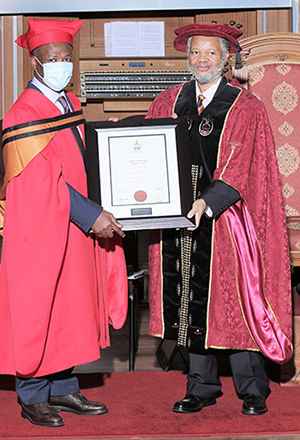
Sandile Luthuli received a special posthumous honorary degree on behalf of his grandfather, Chief Albert John Mvumbi Luthuli, conferred by Prof Mandla Makhanya (Principal and Vice-Chancellor, Unisa).
Fifty-three years after his untimely death, Chief Albert John Mvumbi Luthuli’s life and contribution to the liberation of South Africa (SA) is still receiving global recognition today.
Luthuli, who Unisa Principal and Vice-Chancellor Prof Mandla Makhanya described as "the best among Africans", was awarded the degree of Doctor of Philosophy (honoris causa) posthumously on 4 December 2020.
The degree was conferred on Luthuli by the university to recognise his interdisciplinary revolutionary work in theology, politics and ethics. He was acknowledged for promoting ethics, and an essential quality of humanity contributing to the struggle of black people in SA.
Celebrated by many as the "founding father" of SA’s modern democratic state, who led the African National Congress (ANC) during some of the most dramatic events in its history, Luthuli’s name still echoes with awe and respect.
In 1960, he was the first African to be awarded a Nobel Prize for Peace in honour of his non-violent struggle against racial discrimination.
In his autobiography, Let my people go, Luthuli proclaims Christianity as an accident of upbringing rather than a conscious choice; however, much of his political work and impactful contribution to society was influenced by his faith. When he became religiously conscious for the first time, he was confirmed in the Methodist Church and became a lay preacher. This disposition, the language of the Bible and Christian principles affected his political style and beliefs greatly.
Nonetheless, Luthuli remained an African, though he was a Christian mentored by Europeans both at Edendale and Adams College. "I think as an African, I speak as an African, I act as African, and as an African I worship the God whose children we all are. I do not see why it should be otherwise," he said in his book.
Emancipation and affirmation of women
It was fitting that the posthumous degree for Luthuli was accepted by his grandson, Sandile Luthuli, in the ZK Matthews Great Hall, a concert hall of international standard named after another prominent black academic in SA who was appointed the first African head of Adams College in Natal, where Luthuli was teaching.
"I stand before you today on this solemn occasion on behalf of the Luthuli family who give thanks for the honour that has been bestowed on Chief Luthuli," said Luthuli. By lineage, he added, "it ought to be senior members of our family to receive this coveted honour; however, due to the pandemic gripping the entire world, from which our nation has not been spared, they were unable to attend. But we stand on their shoulders."
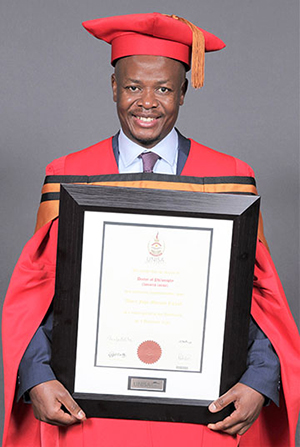
Sandile Luthuli accepted the degree in honour of his grandfather, Chief Albert John Mvumbi Luthuli.
"In many of our dinner conversations about Umkhulu in our family, we often debate on what description or narrative best describes the man," said Luthuli’s grandson, who characterised his grandfather as an African man who stood firmly on gender equality. Luthuli was quite clear on the gender question; he saw women as equals in all spheres. "At home, our grandmother, Nokukhanya Luthuli was his closest confidant; and, as she said in her autobiography, 'Umkhulu will seek her counsel, trust her opinion, and resolutely internalise her advice.'" On that note, he added, "I wish to observe the 16 days of activism on gender-based violence against women and children."
The deep-seated commitment to the attainment of freedom demonstrated by Luthuli was also influenced by democratic values where the voices of people mattered, including those of the youth.
Luthuli’s grandson said he investigated Unisa's commitment on gender equality. "My grandfather would be pleased with the progress this institution is making. The number of key decision-making roles occupied by women in your management ranks should be the envy of your peers," he acclaimed.
According to Luthuli’s grandson, Unisa's role as an institution of higher learning, especially as the only non-racial institution of higher learning during apartheid times, can never be undermined. He stated that the university played a catalytic role and endowed many African economies with trailblazing professionals. "The list is filled with many prominent alumni and there I say this is one of Unisa’s roles that is not celebrated enough."
"Unisa’s traditional tuition model of distance learning is one that needs to be broadened, deepened and spread more than ever before given the ever-growing number of the university entrants into our under-capacitated tertiary education space. Your ability to deliver cost-effective tuition compared to traditional campus-based institutions occupies the niche that should be leveraged to close the access gap for the youth of our nation."
"I am certain that Chief Luthuli would be the first to triumph at Unisa’s role in expanding and deepening education, research and development towards an African based tertiary education offering. In so saying, he would be handing the baton to Unisa’s own contribution to the struggle of black people in SA," said Luthuli’s grandson, concluding his acceptance speech on behalf of the Luthuli family.
It is indeed testament to a country Chief Luthuli has worked for his entire life to realise an Africa where Africans celebrate Africans.
* By Lesego Ravhudzulo, Journalist, Department of Institutional Advancement
Publish date: 2020/12/10


 Unisa co-hosts G20 community outreach in the Eastern Cape
 Unisans gain membership of prestigious science academies
 Unisa alumna takes the helm at the SA Library for the Blind
 Advocating for disability transformation through servant leadership
 Unisa Press continues to illuminate the publishing space