News & Media
Pivot or perish
Unisa’s Graduate School of Business Leadership has embarked on yet another ambitious journey in its quest for international accreditation for its degree programmes and for the business school as a whole.
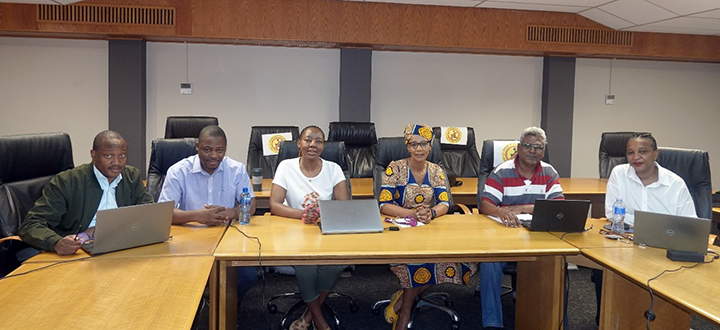
Some of the members of the GSBL International Accreditation Project Planning Task Team
One of the markers of an institution’s agility is its ability to pivot in the face of sudden change. The ability of a project to be agile in the face of unexpected change has never been more necessary than in the past three years since the advent of Covid-19. Failure to pivot has literally resulted in projects perishing with goals remaining unachieved.
The Graduate School of Business Leadership International Accreditation Project has recently been presented with a similar challenge. The Association of MBAs (AMBA), from which the SBL was seeking to obtain accreditation for the Master of Business Administration (MBA) qualification, indicated that they had reached their cap of 300 for the number of schools that they can assess. As a temporary measure, AMBA is therefore not accepting any further applications from business schools. This has effectively brought the AMBA accreditation process at the SBL to a halt.
In light of the above development, the leadership of the accreditation project has had to look at ways in which the hard work which has already been put into the AMBA accreditation process does not go to waste. Based on the professional advice received from the project advisor, a decision has been made to apply for accreditation with the Business Graduates Association (BGA), an accreditation body which is closely associated with AMBA.
Putting things in perspective
It is important for the SBL and Unisa communities to understand the GSBL International Accreditation Project in its correct context. The GSBL International Accreditation project is a project that was approved by the Unisa Strategic and Resourcing Committee (USPRC) in March of 2019. The main objective of the project is to seek international accreditation for the Unisa Graduate School of Business Leadership as an institution or for the programmes it offers from relevant international accreditation bodies. Accreditation is granted by measuring the business school against prescribed standards, principles and criteria of the accreditation body. The business school subjects itself to the prescribed accreditation process with a view to not only obtaining the ultimate stamp of approval, but also to continuously improve its academic excellence, leadership, governance management and culture, financial stewardship, stakeholder focus, and operational excellence and effectiveness.
The first process that the project embarked on was the now-paused AMBA accreditation for the MBA degree programme. The current process is the BGA accreditation, which is accreditation for the entire business school. The BGA looks at everything that is connected to the business school and, as part of their assessment process, selects a sample of two programmes that are offered by the school to evaluate.
The GSBL International Accreditation Project has been erroneously defined and understood by SBL and Unisa communities as the "AMBA Accreditation Project", whereas AMBA is but one of the processes of the project. This has resulted in stakeholders not fully grasping the emergence and place of the BGA process. As the SBL mulls over the possibility of other future international accreditations for the school and its programmes, it has therefore become necessary to clarify the topography of the project. All current and future accreditation processes, including AMBA and BGA, are undertaken under the broad GSBL International Accreditation Project.
The Business Graduates Association
The BGA describes itself as "an international membership and quality assurance body of world-leading and high-potential Business Schools who share a commitment for responsible management practices and lifelong learning, and are looking to provide positive impact on their students, communities, and the economy as a whole."
The BGA exists alongside AMBA in taking business schools through a consultative, developmental process which ultimately culminates in either a 3 or 5-year accreditation. However, where the BGA process differs from AMBA is that whereas AMBA accredits a degree programme, the BGA offers full school accreditation. This means that the BGA considers everything that is connected to the business school. However, the process is less prescriptive and more focused on measurable impact over a period of time. It is considered to be less prescriptive in the sense that business schools wishing to apply for BGA accreditation are required to use the Continuous Impact Model (CIM) to develop a unique range of metrics by which the school can monitor and measure impact and ultimately be evaluated on. The metrics are used to evaluate a business school’s increasing impact on students, graduates and the communities within which it operates. As part of this process, the BGA also samples two programmes that the school offers for assessment. The BGA also allocates an academic mentor and accreditation director to the school for the duration of the accreditation process.
History of the BGA
Initially when AMBA was formed in 1967, it was called the Business Graduates Association. The mission then, as it is now, was to improve the quality of graduate business schools and to increase employment opportunities for business graduates. In 1983, the BGA established its accreditation programme with the MBA as the focus. This was due to the MBA qualification having attained flagship status in business schools. By 2020, AMBA had accredited over 275 MBA programmes in business schools worldwide. However, a gap existed where employers recognised a need for business graduates who "possess a balance between hard and soft skills, innovative capabilities, and a mind-set geared towards being more socially responsible." This meant that business education also needed to adjust to meet this emerging demand from the market. In order to address this demand for a different kind of business school graduate, AMBA relaunched the Business Graduates Association in 2019 to work alongside AMBA, but to have a special focus on working with business schools to increase their impact on students and communities.
The work continues
The project team has gone full steam ahead in immersing themselves into the BGA accreditation process with the SBL having already submitted a Letter of Intent to the BGA in November of 2022. The school has also signed an agreement to adhere to the Cost of Assessment Schedule of BGA.
The potential benefits that the BGA accreditation process promises for the SBL as an institution and its students and communities will have a long-lasting effect. The project team relishes the opportunity to be involved in a process that is so closely aligned with Unisa’s mission to produce excellent scholarship while fostering active engaged scholarship.
* By the Accreditation Planning Task Team, GSBL International Accreditation Project, Unisa Graduate School of Business Leadership
Publish date: 2022/12/12


 Unisa co-hosts G20 community outreach in the Eastern Cape
 Unisans gain membership of prestigious science academies
 Unisa alumna takes the helm at the SA Library for the Blind
 Advocating for disability transformation through servant leadership
 Unisa Press continues to illuminate the publishing space