News & Media
Promoting fair, equitable and diverse global research partnerships
The 7th World Conference on Research Integrity held in Cape Town between 29 May and 1 June 2022, themed "Fostering research integrity in an unequal world", made a strong argument on fairness, equity and diversity in international research partnerships.
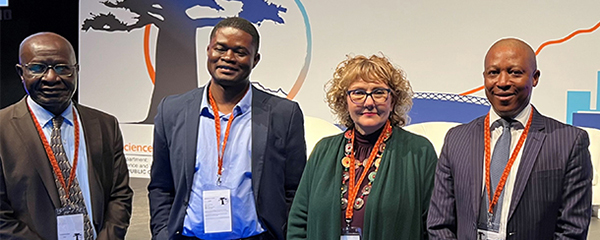
From left: Prof Edwin Were, Moi University School of Medicine; Prof Amos Laar, University of Ghana; Dr Retha Visagie, Unisa; and Prof Ntobeko Ntusi, University of Cape Town
The theme reflects mounting concern, especially among researchers in lower- and middle-income countries about disparities in research partnerships involving partners from wealthy nations.
Ethicists who attended the conference believe that it is high time that research about Africa is led from Africa and by African scientists, instead of African researchers being relegated to subordinate roles, typically as fieldworkers.
The problematic nature of many current international partnerships was extensively discussed. Unisa was represented by Harry Bopape, Director: Research Support, and Dr Retha Visagie, Manager: Research Integrity Office.
Unequal power relationships mar collaborations
"The power imbalances in international collaborative research in low- and middle-income countries can perpetuate unfair research relationships such as fair acknowledgement and authorship," said Visagie.
A background paper entitled "Fostering research integrity through the promotion of fairness, equity and diversity in research collaborations and contexts: Towards a Cape Town Statement" that Visagie co-authored with ethicists and scientists from, among others, Brazil, Nigeria, South Africa, Switzerland, United States and Zambia, was discussed at the conference.
According to the paper, about 90% of research funding comes from high-income countries. This is often cited as the root cause of inequities in international research partnerships. Other factors that negatively affect such partnerships include a lack of trust and transparency between partners, as well as unequal power relations.
The Cape Town Statement refers to a set of shared values and principles that are being developed to characterise fair, equitable and diverse global collaborative research partnerships. The statement should be finalised within the next year.
Visagie explained: "The Cape Town Statement calls on the international community to revitalise the global partnership for sustainable development, in line with the United Nations’ Goal 17 of the Sustainable Development Goals."
Promoting ubuntu and indigenous knowledge
At the conference, ubuntu was identified as a critical underpinning philosophy to be included in the statement, to promote equitable and fair research partnerships. Visagie said: "Stakeholders call for a statement that will promote indigenous knowledge."
Speaking to a science journalist from Research Professional News, Visagie stated: "The Cape Town Statement would be more than an honour code, and would compel institutions and researchers to act on their responsibilities to promote equity, diversity and fairness in research partnerships."
Some facts on the Cape Town Statement and other codes and guidelines on responsible research
While there are several international codes and guidelines on responsible research, the Cape Town Statement is different. It focuses on systemic or macro-level issues concerning partnership inequities. In particular, it aims to
- show that inequity and unfair practices in research collaborations and contexts have an impact on research integrity; and
- identify key values, principles or action guides that can address the issues of equity and fairness throughout the research life cycle.
Codes and guidelines formulated at the previous world conferences on research integrity include the Singapore Statement on Research Integrity (2010), the Montreal Statement on Integrity in Cross-Boundary Research Collaborations (2013), the Amsterdam Agenda (2017), and the Hong Kong Principles (2019).
Unisa has adopted and integrated the Singapore and Montreal statements, as well as the Statement on Ethical Research and Scholarly Publishing Practices into its policies (see the Policy on Research Ethics, and the Policy on Academic Integrity), procedures and practices, including in the evaluation of alleged breaches of scientific standards. The values and principles inherent in these codes are actively promoted through training programmes offered by the Unisa Research Integrity Office.
At a national level, the National Research Foundation, the Academy of Science of South Africa, the Council on Higher Education, the Department of Higher Education and Training, and Universities South Africa, formulated the 2019 Statement on Ethical Research and Scholarly Publishing Practices, which was endorsed by Unisa.
* By Clairwyn Rapley, Department of Research, Innovation and Commercialisation
Publish date: 2022/07/15

 Unisa co-hosts G20 community outreach in the Eastern Cape
 Unisans gain membership of prestigious science academies
 Unisa alumna takes the helm at the SA Library for the Blind
 Advocating for disability transformation through servant leadership
 Unisa Press continues to illuminate the publishing space