News & Media
Quality in the university matters
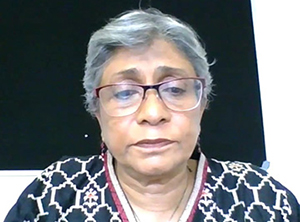
Prof Kethamonie Naidoo, Director: Programme Accreditation, CHE
Prof Kethamonie Naidoo, the Director of Programme Accreditation at the Council on Higher Education (CHE), presented a virtual keynote address on 6 October, themed "Digitally yours, Unisa", at the Teaching & Learning Festival 2020. Naidoo is presently leading the Integrated Quality Assurance Framework (IQAF) project to set up a new quality assurance framework for higher education in South Africa (SA). In her presentation, Naidoo, as the IQAF project leader, shared the journey they had undergone to produce the new framework and the new direction for assuring the quality of higher education (HE) programmes in the context of open, distance and e-learning (ODeL).
Naidoo explained that the CHE focused on how it could improve its efficiency and quality in 2015. Seemingly they did an introspection and realised that they had become too engrossed by technical issues such as the higher education qualifications sub-framework (HEQSF) alignment process. "One of our functions was to revitalise our own intellectual function as a thought leader and to assume our role for our external quality assurance in the sector." She said it was quite an interesting journey where they decided to have a new quality assurance framework. "We formed the task team and plotted the road map for the strategic direction for 2020 to 2025," she said.
"We decided the new QAF had to be a strategic lever to strengthen the responsiveness of SA higher education institutions to social, environmental, technological, economic and justice issues." This, she added, meant finding ways to steer institutions through engagements and the kinds of questions asked about the strategic direction, response to the national development goals, and transformation to reinforce the accountability for quality in institutions, because the primary of quality lies with the institutions themselves.
According to Naidoo, the CHE needs to ensure that institutions should take accountability for producing quality. "We support the institutions to develop these robust quality cultures. We know that we have problems, for example, the kind of violence that we see on our campuses, the quality of our graduates and the commitment of staff, though this varies from institution to institution, however. It is crucial to refocus attention on the academic project, looking at issues like learning, teaching, assessment, curriculum renewal and related issues such as research, and teaching and learning projects so that together we can produce more capable graduates."
"Through these educational programmes in our universities, there should be a personal development for students that enter the gates and leave as graduates. In personal development and personal transformation there are critical skills that are needed for graduates," said Naidoo. She explained that there is a need for a balance between our graduate attributes. For her, "undergoing an educational programme in higher education is far more than just the production of an industry-ready worker as well as graduate employability." It is also about the changing world of work, adaptability, social consciousness, humanity, flexibility, agility and stability needed of these new graduates. She is adamant that this kind of balance is required.
Approved by the council, QAF is an ambitious change management project ready to be implemented. She shared the importance of using QAF as a catalyst to mobilise the university community at all levels in internal quality assurance discussions and planning, ensuring that academics are also central in discussions about learning and teaching. "Institutions need to develop institutionally modified standards, guidelines and criteria aligned to those of the CHE and institutionally diverse contextual realities that form CHE’s engagement on generative and reflective practice."
Naidoo pointed out that there were principles underpinning this new QAF. These principles have resulted in the shifts around this framework. She mentioned the institution's responsibility and accountability in the QA framework. "We know there’s a game played out there where people will submit applications, do the work, earn huge amounts of money, and institutions do not actually know exactly how to deliver the programme about the latest learning and teaching innovation." She also noted that, at times, when a programme gets accredited, it doesn’t lead into practice on the ground the way it’s supposed to. "It’s just a paper exercise and there’s a lot of window dressing; when we do assessments we find that the programme being delivered is nothing like what we got in the application description."
Highlighting the importance of differentiation in terms of the institutional missions and visions, Naidoo stated that institutions are allowed to craft their own quality assurance aligned to their strategic plan. This is a huge shift, because it involves an understanding that we are wasting resources by trying to do in all institutions a "one size fits all". "There are some institutions that require more support, greater interventions and site visits, and there are others that are more well established in terms of internal quality assurance systems. They don't need much support. Our goal is to ensure that those institutions not needing much support get longer time periods between our visits and interventions."
* By Lesego Ravhudzulo, Journalist, Department of Institutional Advancement.
Publish date: 2020/10/09


 Unisa co-hosts G20 community outreach in the Eastern Cape
 Unisans gain membership of prestigious science academies
 Unisa alumna takes the helm at the SA Library for the Blind
 Advocating for disability transformation through servant leadership
 Unisa Press continues to illuminate the publishing space