News & Media
Realism is needed to build the Africa we want
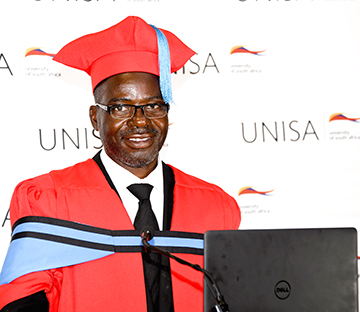
Prof Joseph Chisasa
Realistic expectations are necessary if the African Union (AU) wants to achieve its Agenda 2063 to transform Africa into the prosperous continent it envisions, Professor Joseph Chisasa (Department of Finance Risk Management and Banking) warned during his inaugural lecture.
In his lecture, entitled A risk assessment of the Africa Union Agenda 2063 first ten-year implementation plan, Chisasa reviewed what has been achieved since the launch of the 50-year project in 2013.
Click here to watch a recording of the lecture.
Some 1,36 billion people live in Africa. This represents 17% of the world population. Currently, 43 of the 86 countries in the world that are defined as low-income and food-deficient are in Africa and the number of undernourished people has escalated dramatically. Africans are seen as second-tier citizens of the globe.
Envisioning Africa as an influential global player
Against this background, the AU Agenda 2063 – the Africa we want – is a 50-year plan that is divided into ten-year plans. Rooted in the Pan-African Renaissance, it provides a robust framework for addressing past injustices and shifting the OAU’s original objective from decolonisation to development. It envisages a prosperous continent, with the means and resources to drive its own development.
Some of the other aspirations include a continent that is among the best performers in global quality of life measures such as gross domestic product and equal income distribution, a strong cultural identity, common heritage, values and ethics. It also wants to create an Africa that is a strong, united, resilient and influential global player and partner. Africa realises the need to rise and catch up with the rest of the world. The AU Agenda 2063 is meant to deliver that kind of transformation, Chisasa said.
Yet, Africa is faced with huge challenges because of political, social and environmental constraints. Widespread hunger and diseases such as Ebola, tuberculosis and malaria are just some of the obstacles. Others include a lack of access to finance, fragmented financial markets between formal and informal markets and a lack of title to land due to institutional failures.
Falling short of expectations
For the first ten years the AU identified ten flagship projects. These include an integrated high-speed train network from the Cape to Cairo, an African virtual e-university, a continental free trade area for intra-African trade, an African passport and the free movement of people, the Grand Inga Dam project to generate 43 200 MW of power and an African outer space strategy.
Of these, only the continental free trade area has been implemented.
The COVID-19 pandemic has exposed the fragility of health systems. Growth has been hampered by the adverse effects of the pandemic, fiscal pressures and the very slow pace of vaccinations. At the same time, government debt has increased sharply to 70% of the GDP.
In view of this, it is unlikely that the objective of the first ten years will be realised.
Chisasa suggested that it might be necessary to rethink some of the flagship projects and aspirations. It is, for instance, unrealistic to commit to building a high-speed train network while faced with the continent’s multiple urgent challenges in mind, such as growing hunger and fragile health systems. Projects should be aligned with the continent’s financial resources, he advised. Very big projects must be financed by member states. Because of COVID-19, finances were redirected to fight the pandemic.
Chisasa warned that without attention to the turmoil in Africa, Agenda 2063 is a fallacy and a pipedream. As a result of conflict all over the continent, finance is diverted to security and repairing destroyed infrastructure.
Environmental issues such as the flooding in Mozambique, Malawi and Zambia because of Cyclone Idai also diverted funding away from other projects.
Agenda 2063 is a colossal project. Although it was divided into ten-year plans, this period is too long and Chisasa recommended that the AU consider five-year plans that can be aligned with the presidential terms.
The most urgent and practically possible priority areas of hunger, employment, education, health, peace and security should be tackled first, while an aggressive awareness campaign of the AU Agenda 2063 is necessary to ensure buy-in from the people, he said.
Finally, Chisasa was of the opinion that Africa should invest in research to direct policy. This can be done by entering into partnerships with institutions of higher learning in order to tap into the wealth of expertise residing in these institutions.
* By Ilze Crous, Communication and Marketing Specialist, College of Economic and Management Sciences
Publish date: 2022/03/17


 Unisa co-hosts G20 community outreach in the Eastern Cape
 Unisans gain membership of prestigious science academies
 Unisa alumna takes the helm at the SA Library for the Blind
 Advocating for disability transformation through servant leadership
 Unisa Press continues to illuminate the publishing space