News & Media
Reimagining the futures of higher education towards 2050
Unisa hosted the University of the Future Network (UFN), in partnership with the United Nations Educational, Scientific and Cultural Organization (UNESCO), in a virtual conference on the futures of higher education. The two-day conference brought together eminent scholars, policymakers and relevant stakeholders in higher education to engage in the construction of global visions and pathways for higher education towards 2050.
In her welcome address, Professor Puleng LenkaBula, Principal and Vice-Chancellor (VC) of Unisa, said that the university hosting the conference was a perfect fit since Unisa is an institution that has always been at the forefront of shaping futures in the service of humanity. She stated that Unisa embraces the idea that the contradictions of climatic changes, ecological degradation, humanity's contestations around the notion of ontology and the epistemological and philosophical ideas about creating meaning in the 21st century, are important arenas for higher education, not only just in science and innovation, but also in the creation of knowledge systems that are conducive to promoting social justice and human dignity.
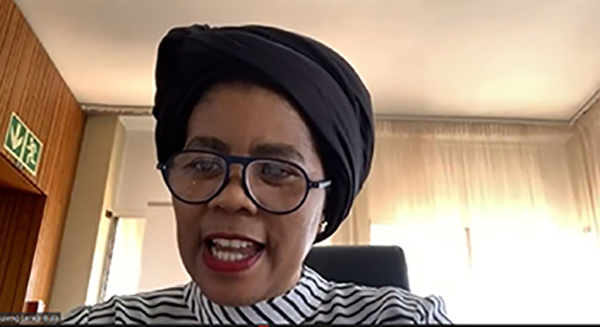
Prof Puleng LenkaBula, Principal and VC of Unisa
She said: “For us to protect knowledge systems, we must ensure that the intellectual futures of South Africa, the continent and the world are protected with an understanding that we do not exist only as individuals, but also individuals who are inextricably bound to society.” The VC added that we have a requisite responsibility to ensure that it is not just liberal humanities or digital humanities that are promoted, “but also those notions that take into cognisance the collectivist approaches that many of us in the continent of Africa practise through the philosophy of Ubuntu. We must therefore be empathetic and caring, and produce knowledge and innovations that are transformative.”
The VC noted that this is particularly important for the future of universities. “Universities in the past were considered elite environments, where only those with the financial resources could advance themselves in their pursuit of wisdom or knowledge,” she said. “The universities of the future, I'd like to submit, are universities that take seriously the imperative for health and well-being in the aftermath of Covid-19 that has made us aware of our vulnerability as humanity. For us, as Unisa, our commitment is not only in thinking around futures where dignity interfaces with ecological justice, it is also around where to access the university and success, and where digital inventions create and mediate distances, whether these be geospatial, disciplinary or multidisciplinary distances.”
The VC stressed that part of the reason that we may be making this attempt is that we would like to ensure that we don't just work with inherited legacies. “While appreciating the evolution and genealogy of higher education, and its history, structures, systems practices, and epistemologies, we should ensure that we reimagine the future in ways that knowledge becomes accessible,” she said. “We must take cognisance of the current trends where growing populations of young people see higher education as a lever for extricating themselves from that which disables them.”
Professor Josep Duart, from the Universitat Oberta de Catalunya in Spain and the UFN, supported the VC’s submissions. “I think that we have a very huge challenge to explore what is happening now and how it impacts higher education institutions,” he said. The transformation universities are currently going through has a direct impact on the educational process.” He added that the current transformation in higher education necessitates a need for new leaders with the capacity to lead higher education to a new era of teaching and learning.
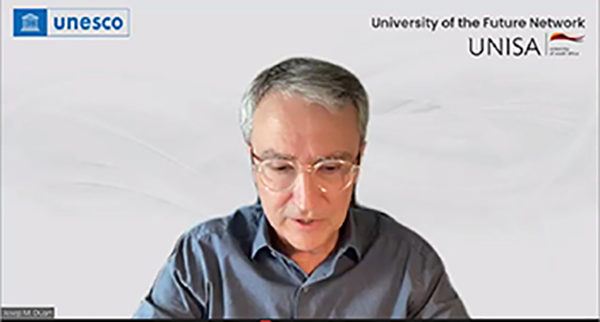
Prof Josep Duart, Universitat Oberta de Catalunya
Sobhi Tawil, Director of the Future of Learning and Innovation team at UNESCO, remarked that it was appropriate that the conference was hosted by a South African higher education institution since South African students have been at the forefront of rethinking higher education and campaigning for genuine access and inclusion, equality and change in higher education. He explained that UNESCO launched the Futures of Education initiative to reimagine how knowledge and learning can help shape the future of humanity, the planet and desirable possible alternative futures. He said that education, as a foundation for inclusive societies, shapes the minds of people across the world as they fulfil their aspirations. “It is a key to resolving many of the global and local challenges we face,” he said. “We cannot heal a damaged planet, narrow huge inequalities, secure the rights of women and girls, strengthen trust or build peace without a strong commitment to education.”
Tawil added that in the face of profound social, political, economic, environmental and technological change, there is a growing consensus that today's education systems are no longer fit for purpose. “This calls for new social contracts for education, a new social contract that can repair past injustices, that can help us meet the unfulfilled promises and commitments that we have made in terms of rights to education for all and at the same time, transform the future,” said Tawil. He emphasised that higher education needs reimagining and a need to recognise the multiple forms of knowledge like cultural and epistemic diversity, recognition and engagement with indigenous knowledge, collaborative action and research with local communities, among other efforts.
Conference participants explored and reimagined the futures of higher education by engaging with future research methodologies and policies required for higher education transformations over the next decades. The resulting conclusions gathered at the conference will be presented at the 3rd World Higher Education Conference (WHEC2022) from 18-20 May 2022 in Barcelona, Spain.
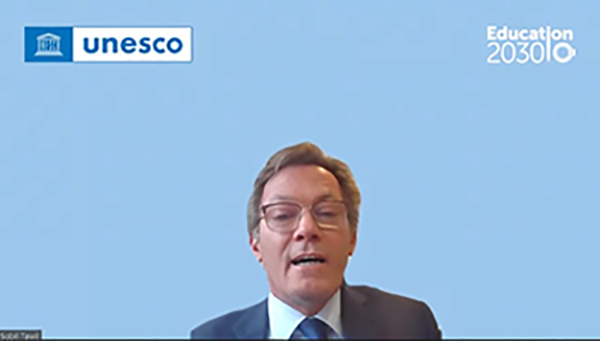
Sobhi Tawil, Director: Future of Learning and Innovation, UNESCO
Among the list of eminent scholars who made presentations at the conference were Unisans Professor Mpine Makoe, Commonwealth of Learning Chair in Open Educational Resources (OER), Thulile Shandu-Phetla, Senior Lecturer, College of Human Sciences, Shila Mphahlele, Senior Lecturer in Early Childhood Education, Gezani Baloyi, Associate Professor in the Department of Adult Basic Education, Kelly Young, Researcher, Institute for Open and Distance Learning (IODL) and Professor Thenjiwe Meyiwa, Vice-Principal : Research, Innovation and Commercialisation.
In closing, the VC said that the higher education we aspire for should be developmental. “Thus, it should offer opportunities for homegrown development solutions, and what we currently call endogenous indigenous knowledge systems, whilst remaining attentive to the global innovation systems,” she said. “We must also try to ensure that we don't just live in the spaces of theorisation and ideation, but must translate to those processes into reality.”
*By Tshimangadzo Mphaphuli, Senior Journalist, Department of Institutional Advancement
Publish date: 2022/02/25


 Unisa co-hosts G20 community outreach in the Eastern Cape
 Unisans gain membership of prestigious science academies
 Unisa alumna takes the helm at the SA Library for the Blind
 Advocating for disability transformation through servant leadership
 Unisa Press continues to illuminate the publishing space