News & Media
Remembering Es'kia Mphahlele’s unyielding spirit
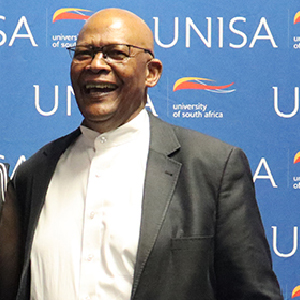
Prof Itumeleng Mosala, Executive Director: Still Nascent Venture & Former AZAPO leader
Presenting the 13th Es’kia Mphahlele Annual Memorial Lecture, Prof Itumeleng Mosala reflected on the life, identity, thoughts and roots of an African giant. The lecture took place at the Unisa North Eastern Region in Polokwane on 8 September 2022.
Celebrating the father of African humanism and a literary legend on World Literacy Day, it was befitting for Unisa to highlight the importance of education. Mphahlele’s intellectual journey forms a big part of his notable contributions in academia and as a Unisa alumnus who completed three degrees through correspondence with Unisa.
Mosala, who had the privilege of working with Mphahlele, is a former Azanian People’s Organisation (AZAPO) leader, the Secretary of the Judicial Commission of Inquiry into State Capture, Fraud and Corruption in the Public Sector including State Organs (Zondo Commission) and an Executive Director of Still Nascent Venture.
"I am the books I read"
In honouring the legacy of the late Mphahlele and recognising his role in the African literary discourse, Mosala brought books to the podium to give impressions on pertinent issues. His lecture was entitled The missing variable and the wrong data set: Prof Es'kia Mphahlele the intellectual.
His focus was on African academics who had left the country during the Apartheid era. "We know that Mphahlele left the country – we know that many great educational minds like him also left the country." Mosala interrogated what could have happened if those intellectuals did not leave the country.
Connecting experiences and numbers, Mosala discussed the importance of finding pragmatic solutions to African problems. Mosala further cross-examined the political reasoning behind the self-exile of black intellectuals in the late 1950s and 1960s, after the advent of Bantu education. He explained that the decisions were occasioned by the passing of an epoch-making piece of legislation known as the Bantu Education Act of 1953 which was effected in 1954.
Equally, Mosala maintained that this lecture of Mphahlele returns African intellectuals to the source. "This is Amilcar Cabral returning to our historical, educational, political and intellectual sources, as a way of searching for the abiding relevance of the man and his scholarly journey over the years," he said.
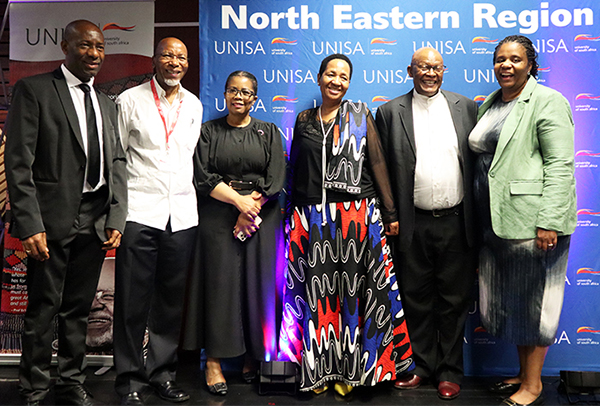
From left: Prof Moloko Sepota (Acting Deputy Registrar: Student Administration & Support Services), Dr Mosibudi Mangena (Former AZAPO leader), Prof Puleng LenkaBula (Unisa VC), Adv Kgoshigadi Moremadi (Adv of the High Court of SA), Prof Itumeleng Mosala (Keynote Speaker) & Prof Grace Khunou (Director: Leadership & Transformation)
Guests at the lecture took lessons from great literary works cited in Mosala’s keynote address. Mosala shared with them the two books that had influenced his reflections. The books are Karl Marx’s Marxism and Religion, and Down Second Avenue written by Mphahlele. "I read the books when I was a staunch Christian believer trying to find out about the existence of both God and the ancestors," he said. Mosala confronted the underlying effects of faith on Africanism and humanism."
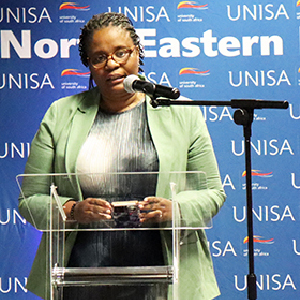
Unisa's Prof Grace Khunou responded at the 2022 Es'kia Mphahlele’s Memorial Lecture: "I could almost hear the heartbeat of Africa – Africa is us and we are Africa."
Sharing excerpts of Mphahlele’s book to contextualise his talk, Mosala said, "In the beginning of 1957 the little imp in me whispered pesteringly: 'Budge, budge!' I was suddenly seized by a desire to leave South Africa for more sky to soar. I had been banned from teaching, and conditions were crushing me, and I was shrivelling in the acid of bitterness; I was suffocating. Apparently, Mphahlele struggled to settle into high-powered writing due the difficult situation in South Africa around those threatening times.
Mosala continued reading the passage: "I despaired often about the education of our children, but I felt I had no right to save them by taking them away, instead of fighting it out side by side with those whose children are also being brought up in a police state." Mosala delved deeper into the dialogue Mphahlele had with himself, his country, his township, village, home and Unisa around the 1950s when the country was challenged with intellectual inequality.
Missing variables and wrong data structure
For an African intellectual like Mphahlele, the decision of giving in to an oppressive system and education was disheartening. Because he needed to build up mental and moral reserves. "Mphahlele resolved his inner debate by saying ‘to budge or not to budge’. It was a matter of working within that system and remain in solidarity with those whose children were similarly having to endure the brutality of a police state and the dehumanisation of its educational system, or to apply for a passport, as he did," said Mosala.
Stimulating academic conversations on literary discourses, Mosala entangled the mathematics and literacy lexicon to depict the brilliance of Mphahlele as a problem solver. "Spreadsheets have cells that contain numbers, most of the time. Those cells are not always all filled with data numbers. In extreme cases one also finds a whole column of a spreadsheet that does not have data. Since columns in spreadsheets are called variables, and rows are called observations, an empty column is called a missing variable," he noted.
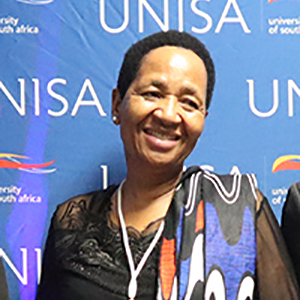
Adv Kgoshigadi Moremadi Mothapo's response was premised on patriarchal versus feminist context. "Had our leaders not budged, had they stayed, we would not see the slight change we are seeing today," she said.
In her welcoming remarks, the Principal and Vice-Chancellor of Unisa, Prof Puleng LenkaBula, concurred that Mphahlele’s writings reflect South Africa and the spirit of Ubuntu. She strongly believes that it is through platforms such as these that the university revisits its mission and the intellectual legacy left by eminent professors such as Mphahlele. LenkaBula stated that Mphahlele was a fountain of knowledge which reignites transformation and the knowledge transfer.
Similarly, Prof Moloko Sepota, the Acting Deputy Registrar in Student Administration and Support Services, declared that the spirit of Mphahlele is much alive, denoting the western way of honouring ancestors and declaring the African way of remembering the spirit that lingers on. Sepota added that Mphahlele’s prophecy continues to strengthen the cultural immune system of African intellectuals.
This year’s memorial lecture, which was facilitated by College of Economic and Management Sciences’ Executive Dean, Prof Mathukhu Mogale, exposed the value of numbers and variables in searching for the truth to locate and solve problems.
Panellists Prof Grace Khunou, the Director of Leadership and Transformation at Unisa, and Kgoshigadi Moremadi Mothapo, an admitted Attorney of the High Court of South Africa, responded to the keynote address, and they expressed their gratitude to the Mphahlele family for attending the lecture since its inception.
* By Lesego Chiloane-Ravhudzulo, Journalist, Department of Institutional Advancement
Publish date: 2022/09/12


 Unisa co-hosts G20 community outreach in the Eastern Cape
 Unisans gain membership of prestigious science academies
 Unisa alumna takes the helm at the SA Library for the Blind
 Advocating for disability transformation through servant leadership
 Unisa Press continues to illuminate the publishing space