News & Media
Role of Jacob Zuma in SA history and human rights under debate
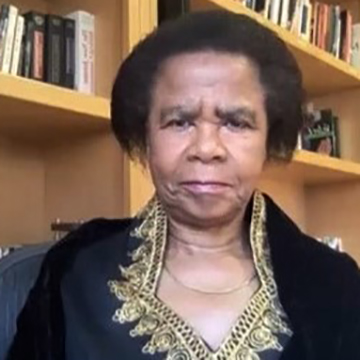
Dr Mamphela Ramphele
Unisa’s third Asikhulume roundtable, organised by the office of the Vice-Principal of Research, Postgraduate Studies, Innovation, and Commercialisation, was hosted virtually on 11 August 2021.
Professor Thenjiwe Meyiwa said in her opening address, “This roundtable aims to ensure that we converse, we talk—as conversations can change the direction of change.” In addition, she said, “As the university and for me as the member of the portfolio, this is very important because we have to create these platforms to engage, to get us to talk, step back, reflect, and think.”
Furthermore, she said, “We are bound to do this as a community, society, and the globe because without conversations we miss each other. We are here to create knowledge, to critique that knowledge, perceptions, outlooks and write about them.”
The topic of the event was Thinking the meaning and role of former President Jacob Zuma in South African history and human rights and Vuyo Mvoko, SABC political editor facilitated the discussions.
Giving her introductory remarks, Dr Mamphela Ramphele, former UCT Vice-Chancellor and anti-apartheid activist, shared her point of departure by saying, “Lets draw on African wisdom.” Ramphele said in African cultural practice when there are major infringements in relationships between members of the family, community, clan, or the wider society, inquiries are often made about what customary traditional rituals and practices could have been neglected or done wrongly, to provoke the wrath of the ancestors.
According to Ramphele, the multiple crises we face today as a young democracy demand of us to ask the question: What infringements or omissions have we committed in the transition to democracy to trigger these crises?
In her reflections, Ramphele stated that the constitution over our democracy has yet to be embraced as a legitimate binding basis for ordering all our relationships at a personal, professional, and political levels.
“Zuma himself has often referred to our constitution in terms that shows he does not honour the constitution but, ironically, when it suits him, he insists on his constitutional rights,” she said.
She mentioned that in 1996 when they adopted the constitution as spelled out in the preamble, they aimed at healing the wounds of divisions of the country’s past and establish a society based on democratic values, social justice and fundamental human rights.
“We agreed to improve the quality of life of all citizens and free the potential of every citizen. This is a homework we gave to ourselves and I would say we are where we are today because we have failed to invest in the process of embracing our constitution through the above agreed processes,” said Ramphele.
Ramphele asked the audience to look at how teachers in schools do not embrace the values of our constitution: “not the values of Ubuntu, human rights, nor the institutions of state, be they government or state-owned enterprises. They never insist that these are values that inform public service practice. The neglect of values in citizenship has allowed emergence the political culture ugly past.”
She concluded: “These values are an instructive socio-economic approach which were part of what colonialism and apartheid was all about. We also see the manifestations of the survival of the resistance politics of the struggle for liberation that still go on today.”
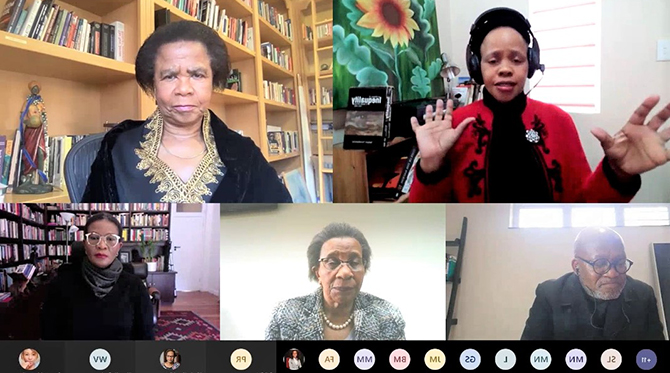
Dr Mamphela Ramphele (former VC: UCT and anti-apartheid activist), Prof Thenjiwe Meyiwa (VP: Research, Postgraduate Studies, Innovation and Commercialisation, Unisa), Prof Nomboniso Gasa (UCT), Dr Brigalia Bam (former Chairperson: Electoral Commission and social activist) and Vuyo Mvoko (SABC).
Delving deeper into the topic, Professor Muxe Nkondo, former vice-chancellor of the University of Venda, said the constitutional court judgement on President Zuma raises fundamental questions on the politics and ethics of public representation. What should we know about the behaviour of public officials, particularly when they make decisions on the allocation of public resources and the delivery of public service?
Nkondo further enquired about interpretations of evidence and what motivates the decisions of a leader in a democratic order that is grounded on transparency, accountability, and public good, predominantly decisions affecting the lives of people at all levels of our society, on the ground, most of the poor and secluded.
Other speakers who deliberated on the topic were Dr Brigalia Bam, former Chairperson of the Electoral Commission and social activist, and Professor Nomboniso Gasa, an esteemed scholar from the University of Cape Town (UCT).
*By Lesego Ravhudzulo, Journalist, Department of Institutional Advancement
Publish date: 2021/08/17

 Unisa co-hosts G20 community outreach in the Eastern Cape
 Unisans gain membership of prestigious science academies
 Unisa alumna takes the helm at the SA Library for the Blind
 Advocating for disability transformation through servant leadership
 Unisa Press continues to illuminate the publishing space