News & Media
Salient points pondered at conference dinner
The third day of Unisa’s inaugural International Teaching and Learning Conference, held at the Muckleneuck Campus, Tshwane, concluded with a special gala dinner on 8 May 2024. The event served to summarise the significant highlights and inputs gleaned from the outcomes of the attendees, a diverse group of eminent scholars, educators, researchers and practitioners from across the globe. This discussion included student-centric measures, inclusivity, African epistemologies and an envisaged look into having administrators as co-constructors of knowledge. The conference, set to conclude on 10 May 2024, has already made significant strides in the aforementioned areas.
African epistemologies
In her welcome address, Prof Zodwa Motsa-Madikane, Vice-Principal: Teaching, Learning, Community Engagement and Student Support, speaking on some of the points gathered during the conference, said she applauds the extraordinary contributions made in scholarship, and the relentless pursuit of teaching and learning excellence through the collaboration between scholars, educators, researchers and practitioners from across the globe, to explore the dynamic and transitional landscape of open, distance and eLearning (ODeL) in the Global South.
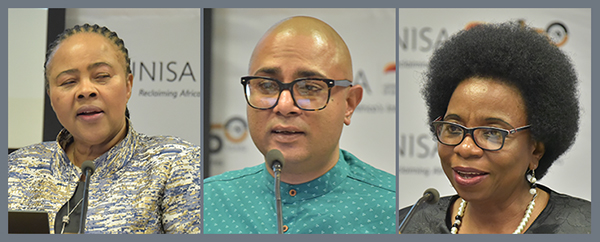
Prof Zodwa Motsa-Madikane, Vice-Principal: Teaching, Learning, Community Engagement and Student Support; Dr Denzil Chetty, Head of Unisa’s Academic Development Open Virtual Hub; and Prof Meahabo Magano, Executive Director: Department of Tuition, Support and Facilitation of Learning
She continued: "We celebrate innovation, inclusivity and excellence, and the opportunity to share and exchange insights while inspiring one another." She affirmed that this gathering is to push knowledge dissemination beyond boundaries.
Motsa-Madikane underscored the significance of African knowledge systems, student-centred pedagogy and technological integration in education. She explained: "Africa remains the source of our knowledge – the source of civilisation, this is why Aristotle and Pythagoras both spent more than twenty years in Africa advancing their studies, learning astrology, medicine and mathematics, before their admission as renowned scholars and thinkers."
Motsa-Madikane acknowledged the continent's rich intellectual heritage and its role in shaping Western thought. She remarked that this conference addressed the importance of tailoring educational approaches to students' diverse backgrounds and needs, and ensuring inclusivity for students with disabilities and promoting their well-being. "We understand the diverse communities that our students come from, therefore, it is pivotal to always remember that Unisa’s students do not have the same socioeconomic and sociopolitical context; therefore, we teach them with that in mind, in part, as a sharp reminder of student-led movements such as #FeesMustFall and #RhodesMustFall, created from sociopolitical and socioeconomic conditions of the country," she affirmed.
On student centricity, Motsa-Madikane said the conference acknowledged the transformative power of teaching and learning, while emphasising the need to actively innovate and ensuring that they do so, driven by student-centric principles.
"In addition," she said, "we acknowledge our strides in empowering the next generation of leaders, thinkers and change makers, including students living with disabilities, in ensuring that they have equal access to education, in recognition of their diverse needs."
In conclusion, Motsa-Madikane commented that the conference serves as a platform to reaffirm a commitment to equitable and transformative education, excellence in teaching and learning, and fostering collaboration and innovation.
A rarity among her kind
Introducing the guest speaker, Dr Denzil Chetty, Head of Unisa’s Academic Development Open Virtual Hub (ADOVH), highlighted Dr Mzikazi Nduna's impressive credentials. Chetty described Nduna as a versatile academic with a rich background in education, training, research, and social justice advocacy. He mentioned Nduna's extensive publications, and further stated that she is a regular guest lecturer at the South African Judiciary Education Institute and an Honorary Research fellow at Stellenbosch University’s Centre for the study of the Afterlife of Violence and the Reparative Quest (AVReQ).
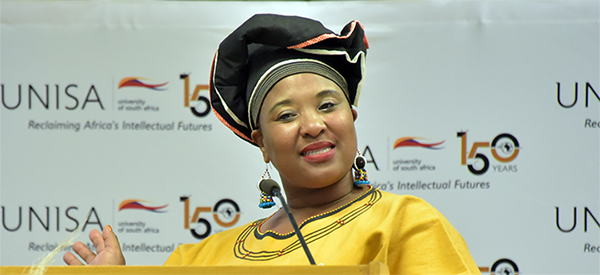
Dr Mzikazi Nduna, freelancer, independent consultant, and an Honorary Research fellow at Stellenbosch University’s Centre for the study of the Afterlife of Violence and the Reparative Quest
Key suppliers of capital
In her keynote address themed Academics and administrators as collaborators in knowledge production, Nduna said that there have been shifts in the higher education landscape in South Africa in that universities are expected to be accountable and responsive to society, the state and the market. She said universities are key suppliers of human capital in an increasingly competitive global marketplace, and acknowledged the key priority of supplying skills that are needed to achieve accelerated economic growth. "This system is possible with collaboration and alignment of all stakeholders so that there is a flow of knowledge and capabilities," she affirmed, adding that this is evidenced by the increase of multi-authored papers.
Administrators as co-creators
Nduna said that administrators have a wealth of data that can be harnessed to help students choose the right course out of their previous merits, during the application and registration processes. "Academics have access to this data through administrators," she stated, adding: "It has been an oversight that the people who collate and manage this data have not been acknowledged in studies that use routinely collected university data."
Nduna argued that there exists a dire need to move towards a system that embraces contributorship, instead of academics working in silos to achieve unique ratings from the National Research Foundation – "a system of contributors instead of authorship or authors," she added.
In conclusion, Nduna pleaded with academics to heed her call to work with administers as co-designers, as collaborators and as co-producers of knowledge, in co-developing research questions, co-planning the research study, co-collecting the data, co-analysing the data, co-writing the reports, and in co-presenting and publishing the results.
This three-day conference at Unisa has served as a vibrant platform for scholars, educators, researchers and practitioners from across the globe to exchange ideas and explore innovative approaches to teaching and learning.
"We have celebrated the transformative power of education, emphasising student-centred principles, inclusivity and the rich tapestry of African knowledge systems," said Prof Meahabo Magano, Executive Director: Department of Tuition, Support and Facilitation of Learning. Magano explained that these discussions, so far, highlighted the crucial role of technology in bridging geographical and social divides, while acknowledging the importance of catering to diverse student needs, including the needs of those with disabilities. "The conference," she said, in conclusion, "culminated with a call for administrators to embrace a co-constructive role in knowledge creation, fostering a more collaborative learning environment for all."
* By Godfrey Madibane, Acting Journalist, Department of Institutional Advancement
** Photography by Shooheima Champion, Multimedia Centre
Publish date: 2024/05/09

 Unisa co-hosts G20 community outreach in the Eastern Cape
 Unisans gain membership of prestigious science academies
 Unisa alumna takes the helm at the SA Library for the Blind
 Advocating for disability transformation through servant leadership
 Unisa Press continues to illuminate the publishing space