News & Media
SAWID holds a solution-guided gathering
The seventh Unisa, South African Women in Dialogue (SAWID) and UN (United Nations) Women held their 2022 annual dialogue, themed Peace, Development and Healing to Achieve Inclusion and Equity #WomensMonth2022Dialogue.
After a two-year non-contact hiatus caused by Covid-19, the Unisa-SAWID-UN Women finally came together bodily to celebrate women's month. This year's event, filled with spontaneous cheers and songs, saw a gathering of politicians, religious leaders, television personalities and student-lead movements to honour the women of 1956 and to recognise the 19th anniversary of SAWID.
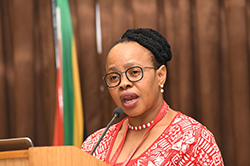
Prof Thenjiwe Meyiwa, Vice-Principal of Research, Postgraduate Studies, Innovation and Commercialisation
The event highlighted several fractures within South African (SA) and global communities that led to Gender-Based Violence (GBV) and disproportionate levels of unemployment for women and girls. There was also engagement on women's participation in national and international trade businesses, and how women can be self-sustainable without relying on government grants.
Speaking about inclusivity in the economy; leading change in the public and private sector, Prof Thenjiwe Meyiwa, Vice-Principal of Research, Postgraduate Studies, Innovation and Commercialisation, gave summative figures on Africa's trade within and outside of the continent, more so, of the much-celebrated Africa Continental Free Trade Area (AfCFTA) which was anticipated to have grown rapidly, but it is still beset with challenges, to the detriment of women.
She said: "Africa globally accounts for less than 6% of global imports and exports. The Intra-African trade accounts for less than 20% - of what we trade amongst ourselves as Africans." Citing the latest research from the Western Cape-based trade law centre (Tralac), a think tank established to assist Africa in trade-related matters, Meyiwa listed several plagues hindering the success of trade in the continent, such as food security, inadequate public health system, lack of rural development, underdeveloped infrastructure and poor water/sanitation and the social justice system.
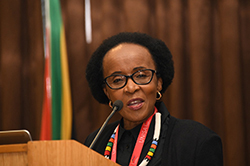
Thoko Mpumlwana, Chairperson of SAWID
Meyiwa affirmed that strengthening Africa's Agenda 2063's primary directive of the Africa we want to see, which includes seven aspirations, is necessary for a prosperous region where stability and progress can occur. These aspirations are prosperity, peace, good governance, democracy and respect.
She also said SAWID should look through inter-trading within municipalities, Africans and more between women. "I invite you to play a role in removing these obstacles to improve the girlhood and the womanhood through trading amongst ourselves, not just with ideas but through resources," Meyiwa added. She also pleaded with the men and women gathered at the venue to join hands collaboratively to prepare a better future for the next generation and to hold each other accountable.
Reflections and review of SAWID
The success of SAWID began during the Inter-Congolese Peace Dialogue, which took place at Sun City, "where the majority of those negotiating for peace were men," said Thoko Mpumlwana, Chairperson of SAWID. She added: "But the exclusion of women exacerbated SAWID members to empower the minority Congolese women delegates to demand an all-inclusive charter."
Mpumlwana asserted: "We are a platform that says we have problems and a solution. We want to be part of the solution in eradicating poverty, do economic empowerment, and ensure skills and education development while keeping it at the core in South Africa and across the continent."
Since its implementation, SAWID has entered into several agreements, which include Unisa, the Foundation for Professional Development, Kagiso Trust, and Gender Links, to promote and advance women's leadership. She said: "As we do our work, we want to be in solidary with other women across the continent and possibly in the world without leaving anyone behind, across political parties, religious divides, age, sexual orientation and everything that divides us."
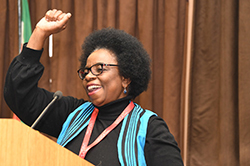
Prof Meahabo Magano, Chairperson of the Unisa Women's Forum
The Chairperson of the Unisa Women's Forum, Prof Meahabo Magano, agreed with Mpumlwana and spoke sternly about the need to stop women from depending on the government's social assistance programmes. She said: "Teach a man to fish, and you feed him for a lifetime," emphasising the importance of teaching society to be self-sufficient.
A shadow pandemic
Alleta Miller, a UN Women South Africa Multi-Country Office representative, said solid and autonomous women's movements such as SAWID matter because they provide the most critical factors in catalysing action to recognise and address gender inequalities. She added that the national strategic plan on GBV and femicide and the first presidential summit on GBV, for example, happened because of the advocacy and non-stop pressure of women's movements.
Miller said: "Violence against women and girls is a pandemic that threatens them daily, mostly exacerbated by Covid-19 under lockdown." She added: "Many were subjected to violence at places where they were supposed to feel safe−their own homes, creating a shadow pandemic." She said that as we continue to commemorate August as women's month, there is a need to come together more than ever to find solutions for peace in communities that will spread to other countries.
Keynote speaker Dr Geraldine Frase-Moleketi, Chancellor of the Nelson Mandela University, said: "Our society needs to work hard to ensure it attains equality. Social and economic transformation is essential because it makes commercial sense."
She concludes: "South Africa needs an economy where every South African, regardless of gender, race, or background, can access basic needs of life and dignity."
* By Godfrey Madibane, Unisa Radio Journalist, Department of Institutional Advancement
Publish date: 2022/08/19

 Unisa co-hosts G20 community outreach in the Eastern Cape
 Unisans gain membership of prestigious science academies
 Unisa alumna takes the helm at the SA Library for the Blind
 Advocating for disability transformation through servant leadership
 Unisa Press continues to illuminate the publishing space