News & Media
Seminal work marks the SACP's centenary
The South African Communist Party (SACP) will be celebrating its centenary in June. To mark this important milestone and turning point in South Africa’s history, Prof Sifiso Mxolisi Ndlovu published The Union of South Africa and the Soviet Union, with a foreword by Thabo Mbeki, former President of the Republic of South Africa and Chancellor of Unisa.
The Union of South Africa and the Soviet Union captures the Communist Party’s history up to 1961, and focuses on its alliance and strategic relationship with the trade union movement, the African National Congress and the Moscow-based Third Communist International. Prof Ndlovu shares more about his book.
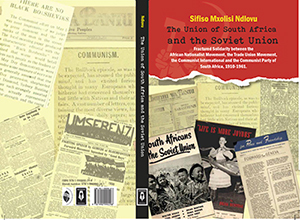
The Union of South Africa and the Soviet Union
From its inception in 1921, the Communist Party of South Africa (CPSA) grappled constantly and seriously with the problem of understanding the South African revolution and how to work in solidarity with the African nationalist movement and the African trade union movement. This was done to support a national revolution for the total abolition of the colonial-style exploitation of the African majority. There was no "religious" revelation in which the truth emerged as pure and complete in a single flash. Truth was relative and had to be searched for painfully and slowly, delivering partial answers. Insights needed testing in practical revolutionary work; everything had to be sharpened, refined and brought closer to perfection, as the inspirational revolutionary work and commitment of Johannes Nkosi suggest so vividly. And, in the course of searching and sharpening, there were shifts of emphasis and direction, which in turn shaped the course of the CPSA’s history.
Revolutionary relationships
In hindsight, the book also makes the point that nothing proved so difficult to resolve, so thorny to understand as the problem of relationships between national and class factors in the South African revolution. That the CPSA veered from position to position in its assessment as it grappled with this problem can be seen in its history. As an example, this history is underpinned by the fact that white communists in South Africa had to accept that African monarchies, unlike Russian tsars, were the first group to resist European colonial forces represented by invading land grabbers and thus, these monarchies were among the first to wage anti-colonial struggles in southeast Africa.
This constant shift of position was also influenced by the heated debates and differences between Josiah Gumede and Pixley ka Isaka Seme, both leaders of the African Nationalist Congress (ANC); by disputes and a battle of minds between Moses Kotane and Douglas Wolton as members of the CPSA leadership; and by Johannes Nkosi’s collaboration with George Champion as trade union leaders. There were times when national factors, such as the African majority suffering overwhelming national oppression, seemed less significant in the mapping of revolutionary strategy than the fact that an organised working class (admittedly of smaller size) was locked in the struggle with its opposite capitalist class and the racist South African state. There were times when the struggles for national liberation waged by the oppressed African majority seemed to mute and diminish the significance of worker struggles, which were divided on racial grounds, with the white workers representing a labour aristocracy.
Strategic reassessment
These constant vacillations in thought leadership cannot be explained by the wisdom or intellectual brilliance of those mentioned above – the people who influenced history at the time. These multiple shifts can be rationalised with the insight of the political experience and understanding gained by these leaders and the practical revolutionary activities, which enabled those in charge to re-interpret their views and to assess and reassess their strategies and tactics. Examples abound in the counter-commemorations of the 16 December anti-pass campaigns and popular struggles. These oscillations were also defined by the eagerness to veer closer to the inevitable comprehension that the road to democracy was by no means straight. It was full of zigzags because, among other things, the racist South African state, supported by Western powers and mining capital, was formidable.
The makers of history discussed in this book also had to take cognisance of the reality that both the state and mining capital acted as a united front in support of the structural violence meted out to the oppressed African majority.
At a glance
In chapters 1 and 2, the focus is on the battle of ideas and intellectual history as defined by the national question in South Africa; chapters 3 and 4 focus on both the political economy and labour history of South Africa; chapter 5 focuses on internationalism and solidarity by analysing the role of the South African Society for Peace and Friendship with the Soviet Union, a civic movement which operated during the mid-20th century and was headed by Reverend Chadwick Thompson. The last chapter, chapter 6, focuses on the Treason Trial of 1956 to 1961, which was essentially a trial against Communism and the proposed use of violence to overthrow the apartheid regime and replace it with a communist state.
Publish date: 2021/05/18


 Unisa co-hosts G20 community outreach in the Eastern Cape
 Unisans gain membership of prestigious science academies
 Unisa alumna takes the helm at the SA Library for the Blind
 Advocating for disability transformation through servant leadership
 Unisa Press continues to illuminate the publishing space