News & Media
Tackling corruption without fear or favour
In honour of the United Nations Convention against Corruption (UNCAC), which was signed in Mexico in 2003, nations of the world continue to join hands to commemorate International Anti-Corruption Day on 9 December annually. While the global theme is "Recover better with integrity", Unisa, the Office of the Public Service Commission (PSC) and the United Nations Office on Drugs and Crime (UNODC) partnered and proposed that the commemoration for 2020 be under the theme "United against corruption for development: Building robust systems for accountability, transparency and integrity".
The commemoration was held virtually, inclusive of prominent representatives such as National Business Initiative (NBI), Ethics Institute and the Directorate for Priority Crime Investigation (DPCI). They had robust interaction around the issue of corruption and how it continues to be a global problem that impacts vulnerable groups such as the poor, deepening inequality in societies.
In his opening and welcoming address, Advocate Richard Khaliphile Sizani, Chairperson of the PSC, highlighted the major incidents of corruption taking place and the key elements of what efforts are being made. Directing the first session, Dr Somadoda Fikeni, Director of VC Projects and Advisor to the Principal, challenged the speakers to ask themselves why countries with good laws continue to have corruption?
Resident Coordinator of the United Nations, Nardos Bekele-Thomas, acknowledged that corruption occurs in all countries regardless of the level of development, but its effects are far more devastating on developing countries as it takes away basic services from the most vulnerable citizens. On the other hand, Regional Representative of the UNODC Regional Office for Southern Africa, Zhuldyz Akisheva, spoke on commemorating International Anti-Corruption Day in the face of Covid-19 and emphasised that tackling corruption is not an option but a necessity.
Committed to openly fight corruption
The keynote speaker, Hon Senzo Mchunu, Minister of Public Service and Administration, indicated that South Africa (SA) as a developing country should align its domestic legislation and policies of corruption with the Constitution of the Republic of SA of 1996 and international standards in order for the country to be a global contender. He acknowledged that all governments in the world should do everything in their power to prevent corruption and for the perpetrators to be brought to book without fear or favour.
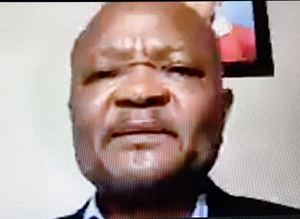
Hon Senzo Mchunu (Member of Parliament and Minister of Public Service and Administration) calls on the public and all sectors to hold hands in the fight against corruption.
"Not only does corruption rob our country of necessary resources for development, but it further violates the constitutional rights of all citizens, leaving them with little or no resources. It counters all efforts of government to deliver on the expectations of the people. Citizens live under the impression that the government does not want to deliver and is not making any efforts; meanwhile, it is corruption that shows its 'ugly' head," said the minister.
Mchunu calls on the public and all sectors to report corruption without fear or favour, adding that fighting it is one of government’s key priorities. He affirms that there is political will from the SA government, which is openly committed to the fight against corruption. Mchunu believes that ethical conduct and organisational integrity are key in eradicating fraud and corruption in public service and administration.
"We acknowledge that as government we have a deficit of public trust and need to regain it, credibility and legitimacy, and make the public service an employer of choice. Public servants must assist government to earn these as it seems that we have lost them… Steadily but urgently, we will overcome the scourge of corruption both in the public and private sectors," he concluded.
Accountability, transparency, and integrity
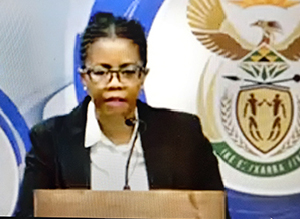
Prof Puleng LenkaBula (Incoming Unisa first female Principal and Vice-Chancellor) moderated the second session of the International Anti-Corruption Day commemoration.
Session 2 of the event was moderated by the incoming Unisa first female Principal and Vice-Chancellor (VC), Prof Puleng LenkaBula. She is currently the Vice-Rector of Institutional Change, Student Affairs and Community Engagement at the University of the Free State (UFS). "As we commemorate International Anti-Corruption Day, it is not only imperative for us to rethink, analyse and evaluate notions of corruption, but we should also ask: What is the context within which corruption manifests? Who are the benefactors and beneficiaries? What are the ideas that perpetuate, manifest and enhance corruption?" she said.
Presenters of this session were Michael Seloane, Commissioner of the PSC, who touched on, among others, the importance of evaluating and strengthening systems of accountability, transparency and integrity; the Chief Executive Officer (CEO) of the National Business Initiative (NBI), Joanne Yawitch, spoke on what is required in terms of ethical leadership from the business sector to successfully address corruption; while Kris Dobie of the Ethics Institute of SA spoke on the need for stable, credible and ethical leadership to combat corruption.
Adding value to the conversation was Dr Lieutenant General Godfrey Lebeya, National Head for the DPCI, who focused on multi-sectoral collaboration in addressing personal protective equipment (PPE) corruption during the Covid-19 pandemic, while David Lewis of Corruption Watch provided an update on the national anti-corruption strategy.
In his vote of thanks, Unisa’s Principal and Vice-Chancellor, Prof Mandla Makhanya said combating corruption is a personal and optimally a collective moral and ethically value-driven commitment and imperative, which looks past personal gain to collective wellbeing and flourishing. He concluded by wishing everyone a blessed and safe festive season.
Part 1
Part 2
* Nancy Legodi, Acting Journalist, Department of Institutional Advancement
Teaser imaged sourced from United Nations Office on Drugs and Crime (UNODC)
Publish date: 2020/12/10

 Unisa co-hosts G20 community outreach in the Eastern Cape
 Unisans gain membership of prestigious science academies
 Unisa alumna takes the helm at the SA Library for the Blind
 Advocating for disability transformation through servant leadership
 Unisa Press continues to illuminate the publishing space