News & Media
The need to transform higher education into a Pan-African 4IR
The Unisa Department of Leadership and Transformation recently held a three-day transformation conference themed Transforming Scholarship After COVID-19 and in the context of the 4th Industrial Revolution (4IR) at the Winnie Madikizela-Mandela Building, Muckleneuck Campus, Pretoria.
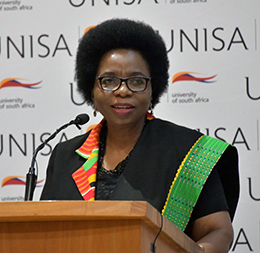
Professor Meahabo Magano
Professor Meahabo Magano, Acting Executive Director of Tuition Support and Facilitation of learning, spoke sternly on the need to have the proceedings of the conference flourish into action and that the deliberations be put to practical use and not just sit on paper. She posed: “Who acts on this knowledge of transformation?” She argued that universities are very good at talking and creating ideation after ideation. “But, what is happening on the ground, and how do we take engaged scholarship there?” asked Magano. She asserted that universities need to work with students to transform the communities they come from.
She added: “Let us kill the silo mentality and go to the ground as a collective to deliver what has been deliberated from this conference; otherwise, universities serve no purpose when they cannot transform communities.” Magano argued that if universities and the knowledge they produce do not filter down to the lower level, then they are not serving their ultimate purpose. “Research should talk to and impact the lives of the communities.
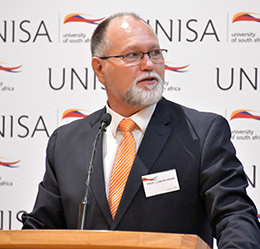
Professor Les Labuschagne
Professor Les Labuschagne, Executive Director of the Department of Research, Innovation and Commercialisation’s address, was imbued by a quote by the Chief Operating Officer of the Project Management Institute, Michael DePrisco: “To be the most effective leader as possible, it is imperative to develop an understanding of where the world is headed, what it means for the organisations and where can we make a contribution.” Labuschagne added that the conference must speak to the realities of students, staff, families and the country and what role Unisa can play.
Will we be ready for the next pandemic?
As the institution moves towards advanced pedagogy propelled by technology, Labuschagne also expressed a strong need to digitise Unisa students so they may be relevant towards the 21st century global needs and be able to mitigate global catastrophes such as COVID-19. “Are we preparing our students for 4IR, or are we preparing them for the past?” he asked. He argues that there is a need to transform how universities put together a qualification to prepare students for 4IR. He added: “There also needs to be a new way of conducting research with new tools to help our students acquire skills to use big data, machine learning and artificial intelligence (AI).” He continued: “ We want to employ people like that, but are we training people like that?”
Keynote speaker, the highly honoured Professor Tukumbi Lumumba-Kasongo, spoke on the theme: Imagining New African Higher Education Systems in the Context of the Fourth Industrial Revolution, Post COVID-19 Exigencies, and the Projection of the African Union’s Agenda 2063: A Reflection.
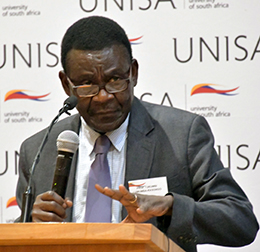
Professor Tukumbi Lumumba-Kasongo
Lumumba-Kasongo’s discourse took a journey which began with the history of Africa’s colonisation and decolonisation and how global politics after that have shaped African countries into what they are today. He said: “Colonialism did not disappear by its own volition, just like Apartheid in South Africa did not stop by itself. There were internal struggles and internationalism that supported independence.”
He continued: “For development to take place, we must stop and think.” He added: “All the developed countries in the world have gone through the process of stopping and thinking, which has taken different forms. In some countries, this was driven by revolutions, while in others, the local indigenous people’s discourse was based on their history until they reached the 4th Industrial Revolution.”
COVID-19 gloomy predictions and Pan-Africanism in 4IR
Lumumba-Kasongo argued that 4IR is driven by artificial intelligence. He further stressed that it has introduced the knowledge economy and has the potential to liberate Africans but also cautioned that it has the embodiment of a monopoly. He said its benefits are organic but asked if they could be permanent. He stated that some scholars argue that Africa was lucky to jump all the stages Europe and the West went through in their three revolutions. However, he said he disagrees with them. He argued instead: “Africa, its cultures, and indigenous communities were not taken into particular cognisance before 4IR.”
Lumumba-Kasongo cautioned that while 4IR has a role in the global system, it should not come near replacing human intelligence. He added: “This revolution promises to accelerate the communication process within nations, improve the way we do agriculture, and use drones for security and military intelligence.” “But who are the people benefiting more from these devices?” he asked.
Higher education towards Pan-Africanism
“COVID-19 has forced us to think differently about higher education. We need to bring higher education to where the people are,” Lumumba-Kasongo stated. He continued: “Karl Max defined people in classes, but we in Africa define them as a collective of individuals within communities.” Lumumba-Kasongo argued that colonial systems did not produce higher education that addressed our African-ness; instead, it profited the colonialists while turning us into subjects. “The knowledge they gave us was to support the existing system. The education the West and Europeans gave us is to study others, but not ourselves. So, they had to study us, the dark continent,” he said.
He argued that higher education in Africa should be founded on the notion that progress is organic. That progress is a matter of everybody and not just a few people. He also asserted that universities should create an agenda where they critique but also learn from society and not become macrocosms.
* By Godfrey Madibane, Acting Journalist, Department of Institutional Advancement
Publish date: 2022/11/24

 Unisa co-hosts G20 community outreach in the Eastern Cape
 Unisans gain membership of prestigious science academies
 Unisa alumna takes the helm at the SA Library for the Blind
 Advocating for disability transformation through servant leadership
 Unisa Press continues to illuminate the publishing space