News & Media
Towards open access for climate justice
Unisa Library and Information Services hosted its annual Open Access Scholarship Webinar on 27 October 2022 to mark International Open Access week from 24 to 30 October. This was the 13th celebration at Unisa hosted under the administration of Ansie van der Westhuizen, Information Resources Developer for Non-commercial Digital Resources.
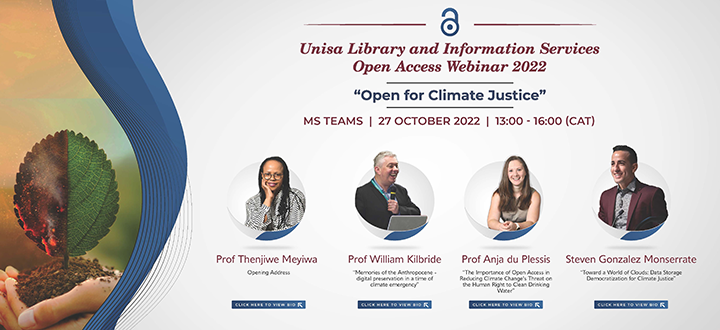
In her opening address, the Vice-Principal: Research, Postgraduate Studies, Innovation and Commercialisation, Prof Thenjiwe Meyiwa, said she viewed the seminar as a milestone for Unisa to rally round and to make a contribution to reclaiming what the Bill of Rights refers to as human rights in the South African context. "Open access to information is crucial and it has a range of implications for knowledge-generating processes, academia, connecting the globe and maintaining the momentum," she said.
"More than storage"
The first keynote speaker, Prof William Kilbride, Executive Director of the Digital Preservation Coalition, presented on the topic of "Memories of the Anthropocene - digital preservation in a time of climate emergency". In his presentation he emphasised that digital preservation is more than storage, and that there is a need to recognise that energy consumption is not the only way in which digital technology impacts the environment, preservation and climate justice.
Kilbride remarked that the virtual world is physical, and manufacturing and disposal of computing equipment has a real and unsustainable environmental cost. He highlighted technical challenges that result in data loss. In his conclusion he gave a brief background to digital preservation and its role in safeguarding memory, which purposes to have healthier, wealthier, safer, fairer and more transparent outcomes upon which climate justice depends.
Clean water a human right
Anja du Plessis, Associate Professor and National Research Foundation Y2-rated researcher, spoke about "The importance of open access in reducing climate change’s threat on the human right to clean drinking water". In her address, she highlighted that water is declining globally and this shortage affects both developed and underdeveloped countries.
"Poor water governance and management," she continued, "is a problem all around the world. Therefore, the human right to clean drinking water is at particular risk. This is the most basic of all human rights, together with sanitation, and a key one in the fight against climate change. The climate crisis is the biggest threat to our survival as a species and is already threatening human rights around the world."
She indicated that climate and water policies should be aligned with improving equitable access to water and reducing climate risks, and that more funding should be made available for adaptation and/or mitigation strategies.
The impact of clouds
Lastly, Steven Gonzalez Monserrate, a PhD candidate from the History, Anthropology, Science, Technology and Society Program at the Massachusetts Institute of Technology in the United States, addressed the online seminar on "Towards a world of clouds: Data storage democratization for climate justice". In his address he highlighted that we need to recognise that climate change reflects a lot of inequities in the world system. "Clouds are the antithesis of open access and are exceedingly difficult to access," he said. In his presentation he addressed the environmental impacts of clouds, which are carbon, water, e-waste and noise. Data centres are consuming a lot of energy and causing blackouts, which are affecting the surrounding communities. He urged us to know about the environmental impact of data and to make facilities publicly available. We need to know the global water usage and the acceptable thresholds for sustainability. We need to grow our own cloud, which will mitigate the need for data storage.
Dr Khomotso Marumo, Acting Executive Director of Library and Information Services, posed the question: How do we, as an institution, move from where we are to climate justice?
An overwhelming number of attendees came from abroad (including Botswana, Eswatini, Kenya, Ghana, Zimbabwe, Namibia, Lithuania, the United States, Nigeria and the United Arab Emirates) and South African universities such as Nelson Mandela, Wits, Fort Hare, Rhodes, the Durban University of Technology and the University of KwaZulu-Natal.
The Unisa Library’s commitment to open access scholarship and publishing via resources such as the Unisa Institutional Repository (UIR), the Unisa Research Data Repository and the Unisa Library Digital Collection demonstrates that open access scholarship reflects the principles of open distance learning.
* By Itumeleng Mpete, Marketing Coordinator, Unisa Library and Information Services
Publish date: 2022/11/16

 Unisa co-hosts G20 community outreach in the Eastern Cape
 Unisans gain membership of prestigious science academies
 Unisa alumna takes the helm at the SA Library for the Blind
 Advocating for disability transformation through servant leadership
 Unisa Press continues to illuminate the publishing space