News & Media
Unapologetic about the transformation agenda
Professor Grace Khunou was recently appointed as the Director: Leadership and Transformation. Khunou’s work is cut out clear, her position seeks to facilitate the transformation of scholarship in line with the Africanisation and decolonisation framework. Since Unisa has built an intellectual hub on decolonisation, she explains that her responsibilities include showcasing the hub’s work and facilitating access to those who have not had an opportunity to engage with the work while inviting new ideas and sharing best practices across the country and continent.
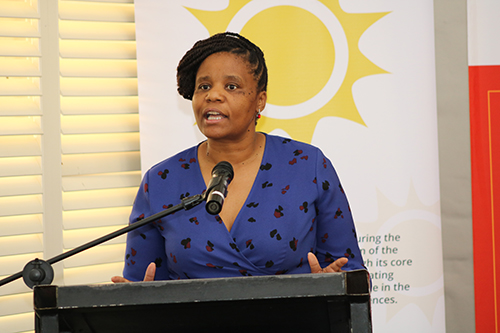
Professor Grace Khunou
Sounds like a task and a half if you think about it. Khunou, however, is only too excited to share her expertise and learn from the reservoir that is Unisa while synthesising to facilitate the Accelerating Transformation to Consolidate the African Intellectual Programme. She lets us in to explain: “This process will entail showcasing the work that has been done at Unisa on transformation, through supporting colleges and entities while further deepening the intellectual project to its African identity,” she says.
“As the VC recently shared in her inaugural speech, we will need to be unapologetic about delving deep into the traditions of knowledge emerging from the African continent while interacting with the world based on this intellectual heritage,” she adds. As a passionate teacher and mentor, Khunou says that she is encouraged by the current opportunities put forward by the changed profile of Unisa students, this in her view, presents an opportunity for the institution and her department specifically to deliberately work with the National Development Plan in ways that can include multiple stakeholders than it is the case when youth is disengaged from social institutions like universities.
She also heartily adds that, “this appointment is a serious opportunity for me to also learn from how this big institution has managed to sustain itself this long and how it has managed to attract senior African intellectuals from within South Africa and the rest of the continent.”
About the Department of Leadership and Transformation
The Department of Leadership and Transformation’s (DLT) primary role is advisory in the context of transformation within Unisa. This includes transformation in curriculum, leadership and the broader intellectual agenda of the university. This department and its roles are a critical function of a university environment and particularly Unisa because transforming knowledge and scholarship is at the core of the university’s drive to implement knowledge-based transformation.
New in the position, Khunou explains that her 2021 plans in the department will be premised on the Principal and Vice-Chancellor’s 2021 theme: Accelerating Transformation to Consolidate the African Intellectual Programme. She explains: “I intend to highlight knowledge and knowledge producers that are usually marginalised (women, gender-non-confirming persons and students) by providing them platforms to share their research. These platforms will be provided throughout the year in collaboration with colleges, external researchers and research institutions within the country, continent and the diaspora.
The transformation agenda
The following Q&A is an illustration of Khunou’s plans on how she intends to build capacity in order to pursue the transformation agenda in the following areas:
Student equity, development and achievements
“I have already been in conversation with the College of Graduate Studies (CGS) and will be facilitating several workshops in their annual programme on research. One of the ways I would like to impact the academic experiences of students is through the provision of mentorship, to not only cater for their academic needs but to impact their values and over skills as citizens. This will also focus on the issues of mental health and gender transformation needs especially given the online learning space we find ourselves in. Covid-19 and our attempts to deal with it has created anxieties for many including staff and students, there’s therefore a need to create platforms where we can re-affirm our community of being a supportive and caring institution while we are seeking outputs.”-
Knowledge, epistemology, scholarship, curriculum, and language
“Centring knowledges that have been marginalised in research and in curriculum, using languages majority of students understand. Most importantly for me, the portfolio I head will allow for the excavation of women and gender-non-confirming person’s knowledges, including herstories in ways that will reclaim especially black women as credible knowers and knowledge producers.”
Staff equity, development, and work experience
“With regards to staff equity, it has been interesting to see how well Unisa is doing quantitatively in comparison with other universities. What I think we need to focus on is to understand the qualitative experiences so that we don’t lose the opportunity to decolonise the usually unchanging institutional cultures found in universities in Africa. If we are going to be successful in building a truly African university, it is not enough to only change the numbers, we need to impact the institutional culture in ways that extend access, showcase excellence, and provide research and curriculum content that is relevant to the context and that informs the international platform. Elimination of barriers that impede staff progress in the academic space, which is predominantly male and white, here we need to deliberately create.”
Career highlights
For this great commission ahead, Khunou brings with her an impressive resume decorated with outstanding achievements and expertise. She followed an academic career after a two-year stint in National Government in the Department of Social Development. She later worked at the University of Johannesburg for a short period as a researcher in the Centre for Social Development in Africa before she moved to the University of the Witwatersrand (Wits) as a Senior Lecturer.
Khunou defines her time at Wits as eye-opening: “Being an academic at Wits gave me an opportunity to affirm my deep interest in knowledge and most importantly in teaching, however it also began to illustrate to me the unequal playing field in ways I had not been privy to as a student. During my first few years at Wits, I realised that I did not have the correct language to speak about or write about my experiences as a Black woman academic; this changed when I joined the University of Johannesburg at the beginning of 2014.”
Khunou spent the last seven years at UJ as a Professor of Sociology and Vice-Dean Research. In 2020, she was a recipient of the UJ Faculty of Humanities Post-Graduate Teaching award
UJ provided me with the platform to do this transformation work in many ways. For example, at the end of 2020 I received the UJ Faculty of Humanities Post-Graduate Teaching award. In the same year, she co-edited book she led – Black Academic Voices: The South African Experience – which won the 2020 National Institute for the Humanities and Social Sciences (NIHSS) Non-Fiction Edited Volume award. The book shares biographical experiences of Black Academics from South Africa, its intention was to redefine knowledge, the knower and knowing. Since its publication, many Black academics have begun to challenge the status quo of inequality in South African universities through sharing their voices and demanding/creating change.
Khunou concludes that she intends to ensure that Unisa is a ‘home’ university for all and does not tolerate any form of discrimination. She also wants to ensure that the institution’s systems and policies are welcoming and conducive for holistic student experiences at the university.
*By Tshimangadzo Mphaphuli, Senior Journalist, Department of Institutional Advancement
Publish date: 2021/03/08


 Unisa co-hosts G20 community outreach in the Eastern Cape
 Unisans gain membership of prestigious science academies
 Unisa alumna takes the helm at the SA Library for the Blind
 Advocating for disability transformation through servant leadership
 Unisa Press continues to illuminate the publishing space