News & Media
Unisa collaborates with Portuguese universities to bring transformation
Unisa recently signed memoranda of understanding with three Portuguese higher education institutions, namely Instituto Superior Técnico, the Camões Instituto Da Cooperação e da Língua, and the Universidade de Aveiro. The collaboration aims to strengthen the links for cooperation between the institutions in the areas of science, engineering and technology.
Areas of collaboration will include promoting the exchange of undergraduate and postgraduate students, joint supervision of Master and Doctoral theses, exchange of faculty members and staff, collaboration in the curricular development, the establishment of undergraduate and postgraduate educational programs and promoting joint research activities among other activities.
Speaking at the signing ceremony, Professor Puleng LenkaBula, Principal and Vice-Chancellor of Unisa, explained that the collaboration between Unisa and the three Portuguese institutions is not only important for the universities, but it is equally important for Portugal and South Africa as the collaboration has the potential to bring transformation in the institutions’ respective societies. “We are excited to partner with the Universidade de Aveiro to support each other in the field of marine studies. We recognise that as human beings, we cannot always agree on how to take care of the planet as it takes care of us. But we must look at opportunities for engagement, where we can find conversions or lessons from each other with each other,” said LenkaBula.
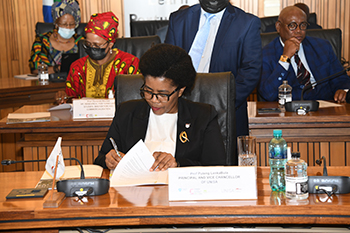
Prof Puleng LenkaBula, Principal and VC of Unisa signs the memorandum
Assertively speaking about the urgent need to address issues around climate change, LenkaBula said academics and students from these institutions need to gather and navigate ways about becoming ecologically conscious. She said: “Our academics and students will be able to stand in the gap of all those animals that cannot defend themselves from human destruction. We believe that our partnership will soon grow to include other fields of studies too. I look forward to seeing the continuation of our joint efforts of building long term and strategic partnerships. We're hopeful that our partnership will not just be limited with the institutions but also in the continent.”
Congratulating Unisa and the three Portuguese institutions on the collaboration, His Excellency Ambassador of Portugal, Manuel Carvalho, said: “I would like to thank Professor LenkaBula who came to my office to explain the strategic vision she had for the university. I just knew that we had to partner Unisa with our institutions in Portugal. My encouragement is that let us reach for the stars.”
LenkaBula expressed gratitude to the South African and Portuguese governments, explaining that the partnerships could not have been possible without their support. Speaking on behalf of the Department of International Relations and Cooperation, Deputy Minister Alvin Botes said that education and skills development are key priorities for the South African government as they seek to promote more opportunities for South African students. The national development plan underscores that by 2030, South Africa should have greater access to post-school education and training programmes through a system that is more responsive to the youth and their educational needs. Botes said: “This particular partnership today between the Republic of South Africa and the Republic of Portugal underpinned by Unisa will strengthen cooperation and collaboration in the field of higher education between the countries.”
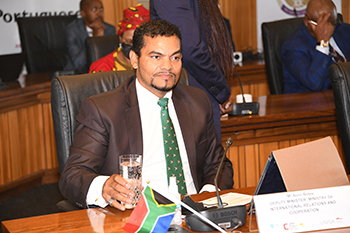
Deputy Minister of International Relations and Cooperation, Alvin Botes
Botes added that the signing of the memoranda of understanding in the field of marine studies, in particular, is the best testament to Unisa’s singular commitment in ensuring that the challenges South Africa is facing in the areas of education and skills development are being addressed. “I'm deeply satisfied that Unisa has reached this critical juncture,” he said.
Botes applauded Unisa under the visionary leadership of LenkaBula. He said: “Your vision to retain space as an innovative leader in distance and open education and to make sure that Unisa does not only become a centre of excellence and provider of access to opportunities for the marginalised, but also a lever of optimum participation in the global knowledge area, is on the road to being achieved,” he said.
“The South African Department of International Relations and Cooperation is confident that this cooperation and these relationships will only grow stronger for the benefit of both our people,” Botes continued. “We therefore look forward to hearing of the fruitful and productive exchanges that will bring about the emergence of high-quality educational dispensation in both countries.”
LenkaBula concluded: “We need to stand and be counted as contributors to solutions to the world’s problems. We must collaboratively work together for a stronger world where humanity flourishes and ecologies are protected. And through this partnership, we hope we will accomplish all.”
*By Tshimangadzo Mphaphuli, Senior Journalist, Department of Institutional Advancement
Publish date: 2022/02/07

 Unisa co-hosts G20 community outreach in the Eastern Cape
 Unisans gain membership of prestigious science academies
 Unisa alumna takes the helm at the SA Library for the Blind
 Advocating for disability transformation through servant leadership
 Unisa Press continues to illuminate the publishing space