News & Media
Unisa Library and Information Services celebrates International Open Access Week
Unisa Library and Information Services hosted a webinar celebrating Open Access Week on the theme Community over Commercialisation. The webinar coincided with the 150th anniversary of the Unisa Institutional Repository and the 77th anniversary of the Library and Information Services.
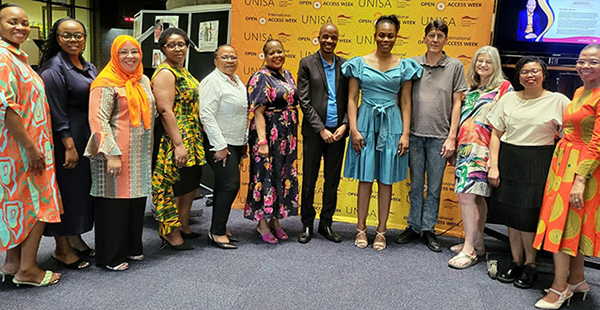
From left: Minah Setumu, Mpho Masingi, Fatima Darries, Dr Khomotso Marumo, Zethu Mazibuko, Dudu Nkosi, Prof Mpho Ngoepe, Itumeleng Mpete, Manuel Rodrigues, Marieta Snyman, Phelisa Bana and Segametsi Molawa
In his opening and welcome address, Library and Information Services Executive Director, Prof Mpho Ngoepe, said that librarians advocate for open access, and libraries are, by design, open access as they build collections to be accessed free of charge, as long as the patrons are affiliated to that particular library.
Ngoepe explained that open access is a set of guidelines and procedures that allow free online distribution of research findings without restricting access. "It is about guaranteeing the accessibility of scientific information, inclusiveness, and the equitable and sustainable nature of its production; hence, 'community over-commercialisation,'" he said.
He further emphasised that the theme attempts to stimulate discourse on the methods of open scholarship, putting the academic community's and the public's needs ahead of the commercialisation of knowledge production. As open access proponents, the time is now to tell and to educate people, the nation and the world about open access. Ngoepe said open access bridges the gap between universities and research institutions as ivory towers in the African and South African context.
In her message of support, the Vice-Principal: Research, Postgraduate Studies, Innovation and Commercialisation, Prof Thenjiwe Meyiwa, said: "One of the most significant scholarly transformation elements is the concept of open access. Through open access, we prioritise community over-commercialisation, foster an environment that encourages the exchange of ideas, promote interdisciplinary collaboration in research and innovation, and support the development of solutions to society's most pressing challenges. Open access empowers researchers, educators and learners across the globe."
Meyiwa said open access is a concept and a transformative force that empowers individuals, fosters collaboration and promotes more innovation. "It aligns with broader goals of transparency, inclusivity and excellence in academia," she said. "Together, we can build a more inclusive, transparent, impactful higher education sector that benefits us all," she added.
Make Africa research discoverable
The first keynote speaker, Dr Nokhuthula Mchunu, Deputy Director of the National Research Foundation, delivered her presentation from Mexico. She focused on how to make African scholarship and research products more discoverable. Mchunu described open science as a vehicle to make generated knowledge accessible, inclusive, equitable and beneficial for all. She encouraged institutions to make knowledge generation more of a public good than a business enterprise.
Prof Meahabo Magano, Executive Director of the Department of Tuition Support and Facilitation of Learning at Unisa, opened her presentation by declaring her love for community engagement, or engaged scholarship, for she believed this was where massive knowledge emerges. She indicated that while universities aim to produce knowledge, the role has shifted to commercialisation. She further touched on the importance of mining knowledge from communities.
Open access publishing
Leen Samarah, a professional from Springer Nature- an academic publishing company, presented the benefits of publishing open access, specifically through Springer Nature. She said there are more than 1.6 million open-access articles and more than 2 200 open-access books through Springer Nature. Samarah said Springer Nature supports open access and making content accessible for everyone.
She explained that the benefits of publishing research open access include the opportunity to reproduce material and collaborate with other researchers worldwide. "The material is immediately accessed online, allowing the acceleration of science. Open access is essential as it reaches people who cannot access this information," Samarah said.
The Unisa Open Access Webinar included attendance by international guests from Eswatini, Zimbabwe, Botswana, Kenya, Ghana, Nigeria and Uganda.
#Unisa150
* By Marita van der Merwe, Manager: Library Administration and Support Services, Unisa Library and Information Services.
Publish date: 2023/11/06

 Unisa co-hosts G20 community outreach in the Eastern Cape
 Unisans gain membership of prestigious science academies
 Unisa alumna takes the helm at the SA Library for the Blind
 Advocating for disability transformation through servant leadership
 Unisa Press continues to illuminate the publishing space