News & Media
Unisa and SAAIR partner to deliberate on the future of education after Covid-19 disruptions
On 15 November 2022, Unisa, in partnership with the South African Association for Institutional Research (SAAIR), hosted the 29th conference at the Casablanca Manor Donkerhoek in Pretoria. The theme of the conference was Reintegration during and after disruption.
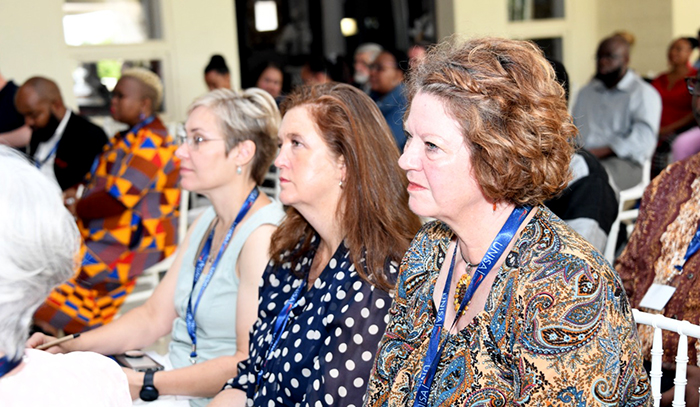
Delegates at the 29th SAAIR Conference
The speakers at the conference deliberated on the disruptions caused by Covid-19 in the higher education (HE) sector and the challenges that affected contact and distance universities. The delegates comprised institutional researchers, planners, quality assurers, members of management and academics.
SAAIR President and the Director of Institutional Research and Analytics at the University of Pretoria, Dr Mxolisi Masango, expressed his appreciation for Unisa to agree in hosting such a noble event. Unisa's Vice-Principal of Strategy, Risk and Advisory Services, Prof Khehla Ndlovu, welcomed the guests and conveyed the importance of the gathering in the context of research and quality education.
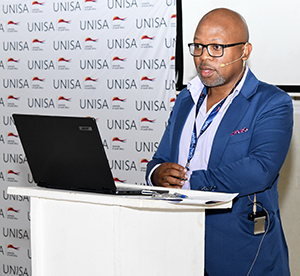
Dr Mxolisi Masango, SAAIR President and Director: Institutional Research and Analytics, University of Pretoria
The conference's opening remarks were delivered by Prof Puleng LenkaBula, the Principal and Vice-Chancellor of Unisa. She reflected on the pandemic and the swift transition it brought into digitalised teaching, student learning, and research. LenkaBula told the audience that the pandemic did not only disrupt the higher education sector but its impact is still felt today in economies and families.
Although she recognised the inequalities and inefficiencies the pandemic introduced to the education sector's system, LenkaBula enjoined the delegates to explore the politics around inequality and inaccessibility as well as access and success. She stated that the pandemic deepened these sacks in the system and laid stark flaws within institutions.
She firmly believes that the lessons learned from the pandemic are invaluable. She said: "We changed, but issues around equality and access are still present." She continued: "The sheer resilience, innovation, empathy and willpower showed across the sector to adapt to the effects of the pandemic held together a sector that easily could have fallen into crisis," she noted.
LenkaBula encouraged the audience to further debate and analyse issues around bias and allow for evidence-based decision-making. Her message challenged African intellectuals to change the plight of society. Closing her address, LenkaBula said everyone has a role to play. She added: "Our planners need to capture the institution's vision and turn it into tangible outcomes to make it a reality." Furthermore, she said: "Our quality assurance teams should find ways to ensure that what we do, when we do it and most importantly, how we do it reflects the best practices in the field."
Prof Romeela Mohee, the Commissioner of the Higher Education Commission in Mauritius, shared the benefits of higher education extracted from the World Bank Studies in socio-economic returns on investment. Mohee also highlighted the challenges that the pandemic has had on education. Furthermore, she presented the importance of improving education's funding frameworks and other philosophies to provide quality education.
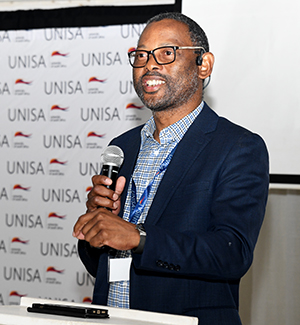
Prof Khehla Ndlovu, Vice-Principal: Strategy, Risk and Advisory Services
Mohee, who once served as the Vice-Chancellor of the University of Mauritius, examined the impact of the climate crisis on education. She also addressed issues about green higher education. Mohee explained how climate crisis could affect infrastructural damage, resource materials, loss of data and records collapse, among many other areas she listed as hazards. She vouched for greening the curriculum, campuses, and site operations to sustain distance and online learning. She urged academics to pay more attention to green higher education.
According to Mohee, most universities were not ready when COVID-19 came in terms of online teaching. For example, in Mauritius, the response to online learning during the pandemic sharply declined from 73.0 % before the pandemic to 40.4 %. This happened during the first lockdown when universities switched from face-to-face to emergency remote learning overnight. However, after the second lockdown, the situation improved.
Referring to the sustainable development goal (SDG) 4, the considerable debate around employability and the future of work in the context of the fourth industrial revolution (4IR), Mohee enquired: "Are we producing graduates that can reduce unemployment?"
Contrary to the visible issues connected to higher education, Dr Britta Zawada, the Director for Institutional Audits, Council on Higher Education (CHE) in South Africa and former Unisan, brought to the attention the background of monitoring and evaluation of institutional audits as an external quality assessment (EQA) activity.
Zawada identified the differences between institutional research and quality assurance (QA) in her address. She gave a detailed background of CHE and its role in education worldwide. As part of the team that led the internal quality assurance and institutional audits at Unisa, she expressed her views on closing the quality loop and the importance of humanising institutional audits.
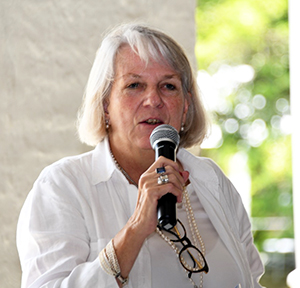
Dr Britta Zawada, Director for Institutional Audits, Council on Higher Education, South Africa
She believes that proper planning helps to reduce the complexity of the project; however, what is more crucial is the difference the process makes in the student's life rather than focusing on bureaucracies, ticking boxes and the administrative part of things. Zawada said that the project was clear on performance indicators and standards. However, she believes it is essential to pause and see if the project was executed correctly rather than focusing strictly on efficiency. She mentioned reflexivity as an evaluation methodology that can improve institutional audits.
After the main speakers, different presenters from South African universities in the field of quality assurance and planning shared their research presentations during parallel sessions. The first session dealt with the pandemic's disruptions to assessing inequalities among university students. Meanwhile, other presenters tackled issues around student support and their needs after considering their biographical data after the pandemic.
Other issues discussed include improvements in engagement in blended learning, the impact of the pandemic on academic performance, an evaluation of cum-laude students, effective online learning in a disrupted space, utilisation of mental health services and the relationship between academics and student support initiatives
The conference was an epic educational adventure highlighting the extraordinary events brought by Covid-19 in the higher education industry and the ripple effects of its uncertainties which are still felt today.
* By Lesego Chiloane-Ravhudzulo, Journalist, Department of Institutional Advancement
Publish date: 2022/11/16

 Unisa co-hosts G20 community outreach in the Eastern Cape
 Unisans gain membership of prestigious science academies
 Unisa alumna takes the helm at the SA Library for the Blind
 Advocating for disability transformation through servant leadership
 Unisa Press continues to illuminate the publishing space