News & Media
Watershed anti-apartheid theological statement revisited
Hosted by Unisa’s Department of Christian Spirituality, Church History and Missiology in partnership with the Ecumenical Leadership Council of South Africa (ELCo), a two-day colloquium on 3 and 4 May revisited the historically significant Kairos Document (KD) which, in 1985, challenged churches' response to the vicious policies of the apartheid regime. The colloquium was themed ‘Revisiting the SA Kairos Document and reimagining the prophetic voice of the church in South Africa’.
Click here for detailed information on the KD.
Present at the event were church leaders, NGOs, academics, youth activists and business leaders from the private sector. Adding to the gravity of the event was the presence of Reverend Dr Frank Chikane, one of the authors of the KD and Chair of the Commission of International Affairs of the World Council of Churches, who spoke as a panellist.
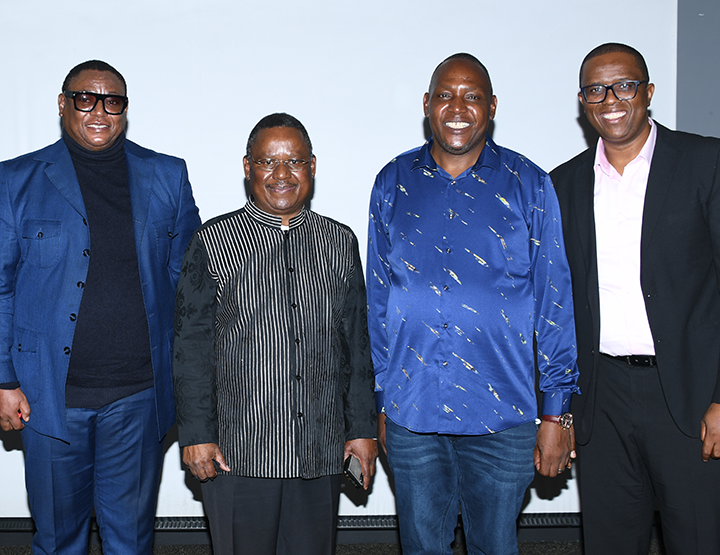
(From left) Prof. Kgomotso Masemola, Executive Dean of Unisa’s College of Human Sciences, Dr Frank Chikane, one of the authors of the KD and Chair of the Commission of International Affairs of the World Council of Churches, Prof. Thinandavha Mashau, Chair of Unisa’s Department of Christian Spirituality, and Pastor Sipho Mahlangu, Unisa alumnus and President of ELCo
In outlining the purpose of the colloquium, Unisa alumnus and President of ELCo, Pastor Sipho Mahlangu, said that, as in 1985, it was once again time to galvanise the church to fight against injustices. ‘After the dismantling of apartheid,’ he said, ‘the role of the church in communities became less pronounced. The prophetic voice of the church had, to a large extent, grown silent. Today, the once united giant, which was a microcosm of South African society, has become ineffective when it comes to addressing the issues facing our communities. The modern-day church operates in denominational and academic silos. As church leaders we must come together again and speak in one voice regarding the social ills in our communities. For the next two days we will be discussing the significance of what I call the Kairos theology, and what we as church leaders are doing in these trying times. We will be reimagining the prophetic voice of the church in South Africa today. The overarching purpose of the prophetic voice is to ventilate certain injustices that exist in our societies, and how we as a church can find a way to address such injustices.’
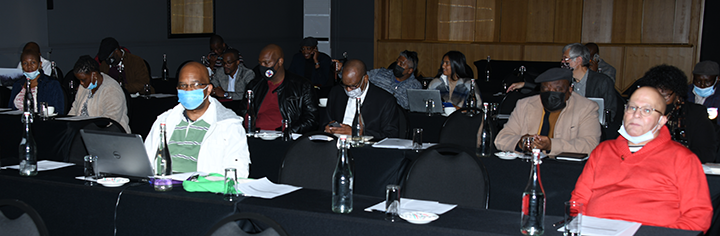
Present at the event were church leaders, NGOs, academics, youth activists and business leaders from the private sector.
After sharing the impact that the KD had on his life and thinking as a young student, Professor Kgomotso Masemola, Executive Dean of Unisa’s College of Human Sciences, read a message from Professor Puleng LenkaBula, Unisa’s Principal and Vice-Chancellor (VC), who was travelling from the United States and could not attend.
In her message, the VC said that the church in South Africa and worldwide had never challenged as vociferously as the Kairos Document did in a very long time. ‘No wonder this 1985 theological statement, better known as the Kairos Document, assumed a historic importance without which freedom for the oppressed would never have been accelerated, she said. ‘We should be grateful that some protagonists behind the Kairos Document are still alive, and it gives me a great deal of inspiration to note the presence of such struggle theologians as Father Smangaliso Mkhatshwa and Reverend Dr Frank Chikane, among others. I humbly but firmly submit that the reimagined future for SA as envisaged by the theologians behind the Kairos Document – long as it took from 1985 to 1994 – expedited the dawn of freedom by decades because it weakened the cornerstone of apartheid – the NG Kerk – which preached the deliberate fallacy of white supremacy and a natural black inferior DNA.’
During the two-day event panellists, with lively audience participation, ventilated different Kairo moments that are part of South Africa’s socio-political and economic discourse, including gender-based violence, drug and alcohol abuse, the Covid-19 pandemic, abuse of religion, social ills such as racism and xenophobia, the pervasive culture of corruption in government, ecological degradation, and global wars.
In addition to Reverend Dr Chikane, the panellists were Professor Thinandavha Mashau, Chair of Unisa’s Department of Christian Spirituality, Church History and Missiology, Dr Pearl Kupe, attorney, activist, international consultant and author, Professor Fundiswa Kobo, senior lecturer in the Department of Christian Spirituality, Church History and Missiology, Reverend Moss Ntlha, General Secretary of the Evangelical Alliance of South Africa, Bishop Malusi Mpumlwana, General Secretary of the South African Council of Churches, Professor Madipoane Masenya, of Unisa’s Department of Biblical and Ancient Studies, and Professor Credo Mangayi, of the Department of Christian Spirituality, Church History and Missiology.
* By Philip van der Merwe, Editor, Department of Institutional Advancement
Publish date: 2022/05/04

 Unisa co-hosts G20 community outreach in the Eastern Cape
 Unisans gain membership of prestigious science academies
 Unisa alumna takes the helm at the SA Library for the Blind
 Advocating for disability transformation through servant leadership
 Unisa Press continues to illuminate the publishing space