

Providing affordable, accessible, high quality, relevant Science Engineering and Technology programmes
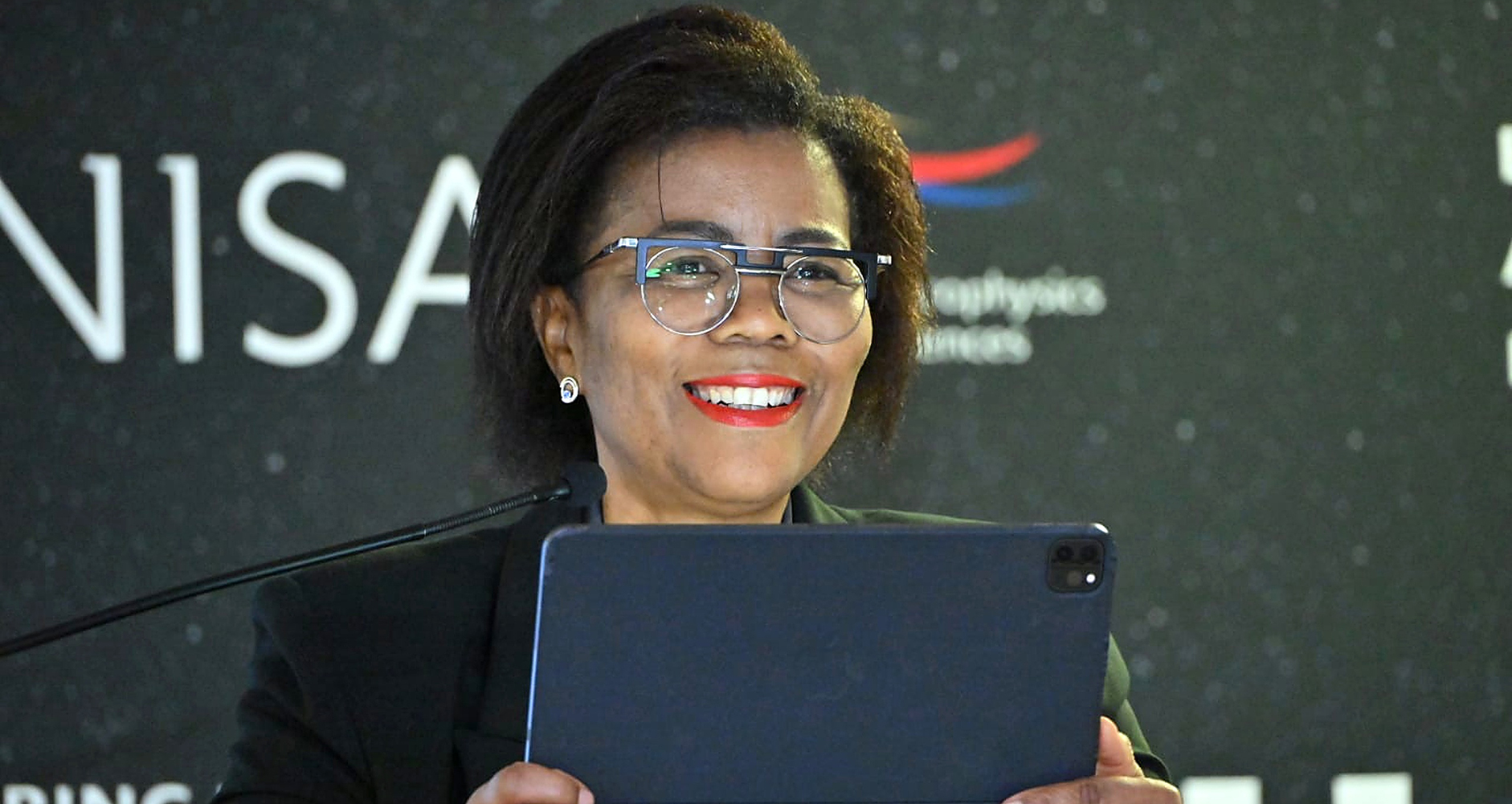
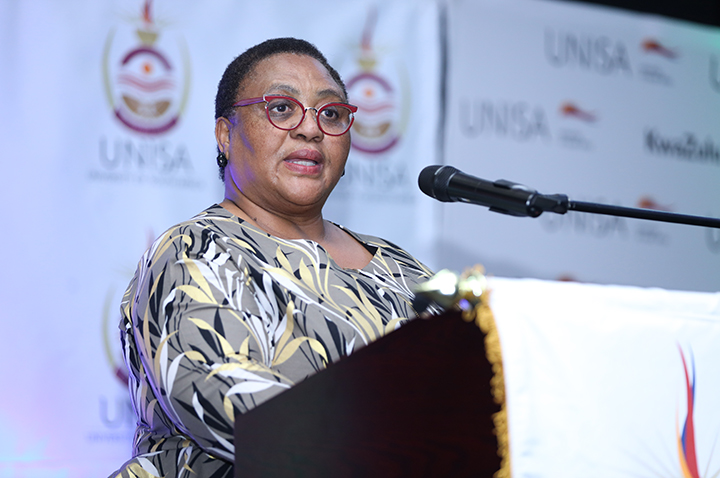
Unisa Vice-Chancellor and Principal Prof Puleng LenkaBula
Astronomy, astrophysics and Africa's growing role in space science took centre stage at a roundtable discussion hosted by the University of South Africa (Unisa), bringing together academics, researchers, students and other guests to explore some of the biggest questions facing modern astronomy.
Led by Unisa Vice-Chancellor and Principal Prof Puleng LenkaBula, the event was held at the Protea Restaurant in the OR Tambo Building on the university's Muckleneuk Campus in Pretoria.
The discussion also provided an opportunity to reflect on Unisa’s growing involvement in astronomy and space science, an area that forms part of the university’s broader research strategy.
Astronomy and space science are located within Catalytic Niche Area 5: Space Studies and the Square Kilometre Array (SKA), one of Unisa's 10 Catalytic Niche Areas (CNAs). The CNAs are strategic areas of scholarly importance through which the university seeks to strengthen teaching and learning, research, postgraduate supervision, innovation and engaged scholarship while contributing to challenges facing South Africa and the wider continent.
CNA 5 specifically seeks to build capacity in astronomy and astrophysics, strengthen research and postgraduate training, and expand Unisa’s contribution to major international scientific initiatives.
Unisa has been involved in the SKA project since 2012 and offers astronomy and astrophysics studies from undergraduate to doctoral level. The university also has the Unisa Observatory, which supports student training and research.
Against this backdrop, the lecture’s focus on Africa’s role in advancing astronomy went beyond an exploration of the universe. It also raised questions about who produces scientific knowledge, how African institutions build research capacity and how the continent can participate meaningfully in major international scientific projects.
Welcoming guests, LenkaBula highlighted the importance of investment in science and knowledge, while acknowledging the work of academics who have contributed to strengthening astronomy at Unisa, including Prof Chibueze, a distinguished professor in the Department of Mathematical Sciences' Astronomy Unit.
She also recognised the role of the National Research Foundation in supporting astronomical facilities in South Africa since the end of apartheid.
"Investing in science and knowledge is critical for our present and future," LenkaBula said.
She pointed to major facilities such as the Southern African Large Telescope (SALT) and MeerKAT, which forms part of the scientific infrastructure supporting the development of the SKA.
For LenkaBula, astronomy also has a role to play beyond research institutions and observatories. She stressed the importance of making science accessible and using education and training to expand opportunities for communities.
"Astronomy can serve as a unique bridge, inspiring young minds and helping to foster skills," she said.
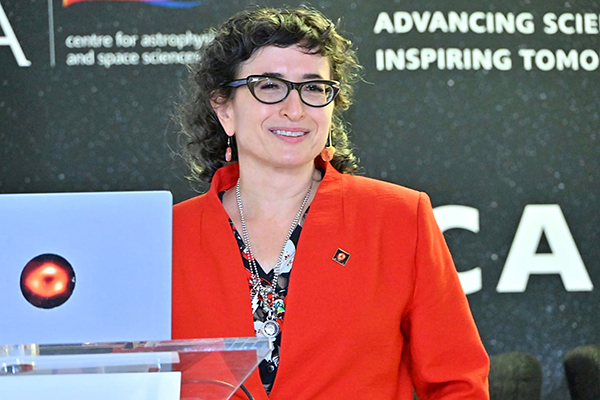
Prof Sera Markoff of the University of Cambridge
The keynote speaker, Prof Sera Markoff of the University of Cambridge, took the audience into the world of astrophysics, explaining complex concepts in a way accessible to an audience beyond specialist researchers.
Markoff discussed black holes, the Event Horizon Telescope and the methods scientists use to understand some of the most extreme objects in the universe. She used familiar references, including the film Interstellar, to help illustrate concepts that can otherwise be difficult to visualise.
She explained that scientists can study black holes by observing the light and other radiation produced as matter interacts with them.
One example is Sagittarius A*, the supermassive black hole at the centre of the Milky Way. Its mass has been estimated at four million times that of the Sun, based in part on observations of the orbits of nearby stars.
"Black holes are not just cosmic vacuums," Markoff said.
"They reveal explosive jets of magnetised plasma that regulate the growth of stars and galaxies, acting as nature’s grand accelerators."
Her presentation provided a scientific entry point into a broader conversation about the role of astronomy in developing knowledge, technology and skills.
That broader perspective closely mirrors the intention of Unisa's Space Studies and SKA catalytic niche area. The CNA is not limited to studying stars, galaxies or black holes. It is also concerned with building the research and human capacity required for African participation in a field increasingly shaped by large international scientific collaborations and sophisticated technologies.
The lecture therefore offered a practical illustration of how the CNA can operate as more than an institutional research classification. It brought together fundamental scientific inquiry, postgraduate development, international collaboration and questions about Africa’s position in global science.
The discussion also highlighted developments within Unisa’s astronomy programme.
LenkaBula referred to work by Prof Mamba and Prof Dube to strengthen astronomy at the university and support its growth as an area of research and postgraduate training.
Among the developments is the establishment of the Unisa Centre for Astrophysics and Space Sciences, which has more than 50 students and facilitates academic collaborations with institutions outside South Africa.
Prof Mamba also highlighted investments linked to the development of astronomical infrastructure, including R40 million committed to the Africa Millimetre Telescope project in Namibia.
The project is part of a wider effort to expand astronomical capability on the continent and develop a regional workforce equipped with the skills needed to participate in astronomy and related fields.
For Unisa, this connects directly with the purpose of its catalytic niche approach: using areas of strategic academic strength to develop research capacity while creating opportunities for teaching, postgraduate education, innovation and collaboration.
Africa's participation in astronomy is particularly significant as the continent continues to host and contribute to major scientific facilities and international research initiatives. Building the skills required to operate, interpret and develop these technologies is therefore as important as the infrastructure itself.
The discussions at Unisa highlighted both dimensions. The science of black holes and distant galaxies provided the intellectual focus, while the questions of education, research capacity, infrastructure and collaboration pointed to the wider significance of astronomy for Africa.
The event ended with a renewed emphasis on collaboration and education, reflecting the role Unisa seeks to play through its Space Studies and SKA catalytic niche area: developing knowledge and skills that enable African researchers and students to contribute to, and increasingly shape, the global scientific conversation.
* By Sipho Jack, Journalist, Department of Institutional Advancement
Publish date: 2026/09/22

 Unisa strengthens global standing in 2027 Times Higher Education World University Rankings
 Unisa, UCT and University of Bristol strengthen partnership to transform global research collaboration
 Prof Lessing Labuschagne takes helm of Unisa's Research and Innovation portfolio
 Unisa Spring Graduation opens with stories of perseverance and achievement
 Unisa academic helps develop AI system to stay ahead of cryptocurrency scams