

Providing affordable, accessible, high quality, relevant Science Engineering and Technology programmes
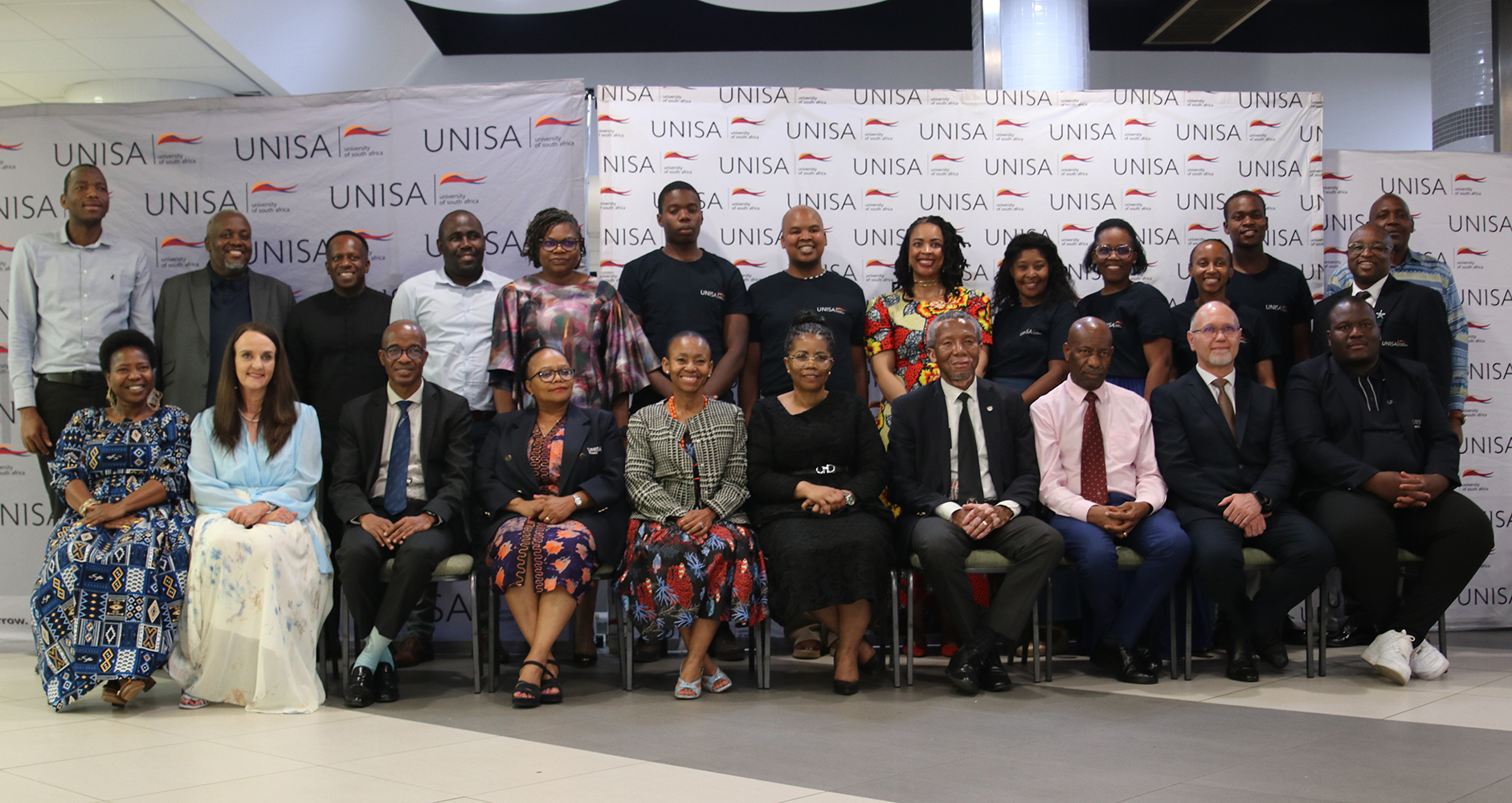
Group photo of MANCOM with Team Solulu Elevate and Unisa employees
A team of University of South Africa (Unisa) students has developed an artificial intelligence (AI) solution designed to identify learners at risk of falling behind and connect them with academic support before their difficulties become barriers to success.
Known as Team Solulu Elevate, the students emerged victorious in Unisa's 2026 Hackathon after developing an AI-powered early-warning system that could transform how the university identifies and supports disengaged students. The innovation is designed to monitor indicators such as reduced participation on university learning platforms and missed assignment submissions, allowing potential academic difficulties to be identified earlier. Rather than waiting until students fail assessments or withdraw from their studies, the proposed system would proactively contact those showing signs of disengagement while notifying lecturers of cases that may require intervention.
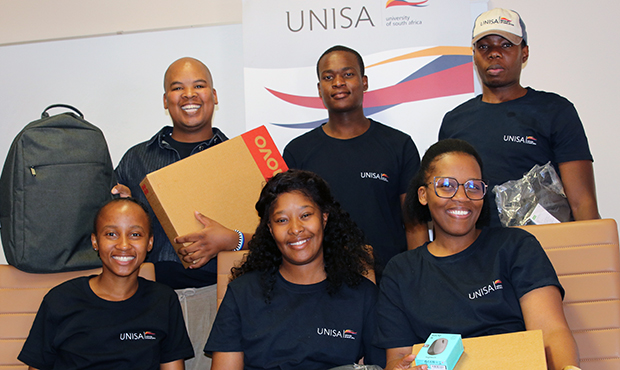
Team Solulu Elevate: Standing from left: Thabo Horings, Hlulani Ndlovu, and Anele Mabaso. Sitting from left: Imitha Kopolo, Matelile Augeal, and Magdeline Maluleke
The achievement was recognised by Unisa's executive management on 20 October 2026, when the winning team met with Principal and Vice-Chancellor Prof Puleng LenkaBula and members of the university's Management Committee (MANCOM). The recognition marked an important step in Unisa's efforts to position students not only as users of emerging technologies but also as innovators capable of developing solutions to challenges affecting their own educational experiences.
Held from 21 to 23 September 2026 at Unisa's Science Campus in Florida, the hackathon was organised by the Information and Communication Technology (ICT) Portfolio in collaboration with the College of Science, Engineering and Technology (CSET). Under the theme The Agentic University: Reimagining Unisa with AI, the competition challenged students to explore how artificial intelligence could be used to address practical institutional problems. The emphasis was on agentic AI, an emerging approach to artificial intelligence in which systems can perform tasks and take actions towards defined objectives with varying degrees of autonomy.
Unlike conventional AI applications that primarily respond to individual instructions, agentic systems are designed to coordinate actions and respond to changing information within established parameters. For Unisa, the challenge was to encourage students to move beyond theoretical discussions about AI and demonstrate how the technology could improve university services and student experiences. Thabo Mogašwa, ICT Technical Lead, mentor and hackathon judge, explained the technological ambition behind the competition.
"We want a type of AI that is autonomous in the work it does," he said. The competition's shortlisting process began on 26 August 2026, eventually producing three finalist teams: BioSecure, AskThuso and Solulu Elevate. The finalists were tasked with developing and presenting solutions capable of addressing challenges within the university environment. The three-day programme combined technical development with mentorship, teamwork and practical problem-solving.
The opening day focused on information briefings, challenge allocation and idea generation, allowing participants to understand the problems they were expected to address. Students then moved into intensive development, refining their concepts and translating their ideas into functional prototypes. The second day concentrated on coding, testing and preparing presentations, while the final day featured demonstrations and evaluation of the proposed solutions. Throughout the competition, participants received technical guidance and strategic support from a multidisciplinary mentorship team.
The initiative was led by Prof Mampilo Phahlane, Head of the Department in CSET's School of Computing, alongside Dr Motlokwe Thobejane, Executive Director: ICT Infrastructure and Systems; Dr Marothi Lemekwane, Acting Executive Director: ICT Governance, Risk and Compliance; and Dr Khanyisile Twabu, Acting Deputy Director: ICT Academy of Applied Technologies and Innovation. Their involvement helped connect students' technical ideas with the university's operational needs and broader digital transformation priorities. Stanford Mphahlele, Acting Director: ICT Systems, Enhancement and Maintenance, who also served as a judge and mentor, commended the quality of the finalists' work.
He highlighted the winning team's strong student-centred approach and the effectiveness of its presentation as important factors in its success. Team Solulu Elevate's winning concept addresses a challenge faced by many universities: identifying students who are becoming academically disengaged before their difficulties lead to poor performance or withdrawal. The proposed system uses AI to identify warning signs, including declining activity on learning platforms and missed assignment submissions.
Once a potential risk is detected, the system is designed to initiate contact with the student and offer appropriate assistance. At the same time, it would notify lecturers, enabling them to assess the situation and provide additional academic support where necessary. This proposed two-way communication process aims to strengthen the connection between students and academic staff while reducing delays in responding to emerging learning difficulties. For an open distance e-learning institution such as Unisa, where students often study remotely while balancing employment, family and other responsibilities, timely intervention can be particularly important.
Students may encounter difficulties without the immediate face-to-face interaction available in conventional campus environments. Digital systems that help identify changes in academic participation could therefore provide an additional means of connecting learners with support. However, the success of such a system would depend on its ability to distinguish genuine disengagement from temporary changes in activity, protect students’ personal information and ensure that automated alerts lead to meaningful human assistance. The proposed technology is intended to support, rather than replace, the professional judgement of lecturers and existing student-support structures.
By placing students' experiences at the centre of the design process, Team Solulu Elevate demonstrated how technological innovation can respond directly to institutional challenges. The winning team brought together students from different Unisa colleges, combining diverse academic backgrounds, perspectives and technical abilities. Although this diversity ultimately strengthened their approach, the students acknowledged that working together presented several challenges. Some team members met for the first time during the competition, leaving little opportunity to establish working relationships before development began. They also had to contend with limited preparation time, differences in communication styles, competing ideas and the pressure of completing their prototype within three days.
For some participants, the competition required them to refresh their coding skills while simultaneously learning new technical concepts. Despite these difficulties, the experience strengthened their ability to collaborate, manage disagreements and solve problems under pressure. The team described the hackathon as an opportunity for both technical development and personal growth. Their experience reinforced an important lesson about innovation: successful technological solutions require more than coding ability. They also depend on communication, adaptability, teamwork and a clear understanding of the people they are intended to serve.
The mentorship team praised the students' diverse backgrounds and their ability to translate different perspectives into a shared solution. Their approach reflected the principle of technology for humanity, which places human needs and social benefit at the centre of technological development. The hackathon received support from Unisa's executive leadership, including Vice-Principal: ICT and Chief Information Officer Mathabo Nakene-Mginqi. Reflecting on the purpose of the initiative, Nakene-Mginqi emphasised that the competition was intended to test students' ability to develop practical solutions to challenges they understood firsthand.
"We did not set out to produce seven products. We set out to find out whether the students of this university, given three days and some support, could take their own problems and build answers to them," she said. Her remarks captured the broader purpose of the initiative: creating opportunities for students to participate directly in institutional innovation.
Rather than relying exclusively on external solutions, the hackathon demonstrated the potential value of drawing on students' experiences, creativity and technical knowledge. The winning team's achievement was further recognised during its engagement with LenkaBula and MANCOM on 20 October 2026 at Unisa's main campus. Team members were presented with new laptops in recognition of their work. The students also received prizes supported by partners including Nedbank, Telkom and Huawei, reflecting the role that collaboration between universities and industry can play in developing emerging technological talent.
In addition, Unisa's management awarded the winners an extra R3,000 in vouchers and committed R100,000 towards further innovation and potential commercialisation of their system. The funding creates an opportunity to explore how the prototype could be developed beyond the competition, although further technical assessment, testing and institutional approval would be required before any operational implementation. The recognition of Team Solulu Elevate highlights the importance of ensuring that promising student innovations have opportunities to progress beyond competitions. While the hackathon demonstrated the team's ability to develop a student-centred concept within a limited period, translating that concept into an operational university system would require further development. For an AI-powered student-support platform, important considerations would include integration with existing learning systems, reliability, accessibility, data protection and the appropriate use of automated decision-making.
The system would also need to operate within applicable privacy requirements and institutional governance arrangements, particularly because it would process information relating to students’ academic engagement. Its effectiveness would ultimately depend not simply on detecting warning signs but on whether those alerts result in timely, appropriate interventions that improve student experiences and academic outcomes. The R100,000 commitment towards innovation and potential commercialisation provides an opportunity to investigate these next steps.
If successfully developed and evaluated, the concept could contribute to strengthening proactive student support within Unisa’s open distance e-learning environment. Beyond the winning prototype, the hackathon formed part of Unisa's broader ambition to develop students who can use emerging technologies to address social, educational and economic challenges. The initiative encouraged participants to apply classroom knowledge to real-world problems while developing practical skills in coding, teamwork, innovation and entrepreneurship. It also reflects the growing importance of digital capabilities in preparing graduates for a changing world of work.
These priorities align with Sustainable Development Goal (SDG) 4, which promotes inclusive and equitable quality education, particularly through the development of skills and learning opportunities. The competition also contributes to the objectives of SDG 9, which promotes innovation and technological development, while the winning concept has potential relevance to SDG 10 through its focus on identifying students who may require additional support to participate successfully in higher education. At a national level, the initiative supports the National Development Plan 2030's emphasis on strengthening education, developing skills and expanding South Africa's capacity for innovation. It also resonates with the African Union's Agenda 2063 vision of a prosperous continent driven by education, science, technology and the development of a skilled population.
Within Unisa, the initiative demonstrates the practical relevance of research and innovation associated with digital transformation and Fourth Industrial Revolution technologies. Importantly, the hackathon also reflects the university's commitment to developing entrepreneurial thinking by encouraging students to see themselves as creators of solutions, potential innovators and future employers rather than solely as job seekers. Prof Simi Dube, Deputy Executive Dean of CSET, praised the quality of the students’ work and the initiative’s contribution to developing practical skills. "Quality is very important because the students we are celebrating today demonstrate the high calibre of learners at Unisa," she said.
Dube highlighted the significance of students moving beyond conventional academic assessments to become active participants in developing solutions to real-world problems. For Team Solulu Elevate, the victory represents more than winning a competition or receiving prizes. It is an opportunity to demonstrate that students can contribute meaningfully to improving the institutions in which they study. Their proposed early-warning system reflects an understanding that educational success depends not only on access to learning opportunities but also on the ability to identify and respond to challenges before students fall behind.
As Unisa continues exploring the potential of artificial intelligence, the 2026 Hackathon offers an example of how student participation, academic expertise and institutional support can come together to advance practical innovation. The challenge now is to build on that momentum, strengthen promising prototypes and create pathways through which student-led ideas can develop into sustainable solutions. For Team Solulu Elevate, the achievement marks a promising beginning. For Unisa, it reinforces the value of placing students at the centre of technological transformation.
* By Nontsikelelo Ndebele, Communications Intern, Department of Institutional Advancement
Publish date: 2026/10/22

 Unisa hackathon winners develop AI solution to support students at risk of falling behind
 Beyond Black Wednesday: Unisa lecture calls for urgent action to protect media freedom and public broadcasting
 Unisa celebrates 25 new PhD graduates advancing research and innovation
 From Maramanzhi to master's: Unisa graduate champions Tshivenda through scholarship
 Unisa students help shape digital complaints system to improve accountability and service delivery