News & Media
Taking transformation in higher education beyond the legacy of history
The Department of Leadership and Transformation (DLT), in the office of the Unisa Principal and Vice-Chancellor, is hosting its 2023 Transformation Conference under the theme The SA higher education transformation journey: Analysis of the present, informed by the past from 4 to 6 October 2023.
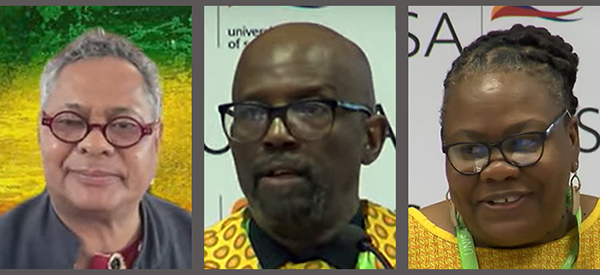
Panellists, from left: Prof André Keet, Prof Nhlanhla Maake and Prof Nokuthula Hlabangane
The conference provides academics, researchers, transformation managers, higher education practitioners and leaders, representatives from government and graduate students with a forum to exchange ideas relating to transformation of the higher education sector.
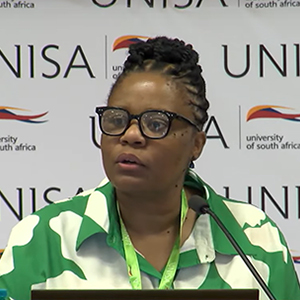
Prof Grace Khunou, Acting Executive Director, DLT
Introducing the panellists speaking on Transformation: Then and now on the first day of the conference, Prof Grace Khunou, Acting Executive Director, DLT, said that transformation that is symbolic only, equates to failed transformation. "I am not in the business of failing," she told the audience, "and I suspect you aren’t either. So we have to do substantive work irrespective of how difficult it is, or whether doing it will lead to career limitations. The business of transformation means going out there to do the hard, difficult work, and asking the difficult questions. This is exhausting work, and one of the objectives of conferences such as this one is to allow us to revive, to reimagine, and to move on from discouraging moments."
Transformation challenges: A bird's-eye view
Prof André Keet, Deputy Vice-Chancellor for Engagement and Transformation at the Nelson Mandela University and incumbent of the Research Chair for Critical Studies in Higher Education Transformation (CriSHET), joined the conference virtually and spoke on the topic The state of transformation in South Africa’s public universities.
Keet unpacked the Ministerial Oversight Committee on Transformation in the South African Public Universities’ 2023 report on transformation at public universities, highlighting important aspects and presenting conference attendees with a fresh perspective on the findings and recommendations.
One of the aspects he highlighted is the need to go beyond the legacy of history regarding transformation in the higher education sector. "From a transformation perspective," said Keet, "both historically advantaged and disadvantaged universities face inherent challenges rooted in their historical origins and development. Some challenges are perpetuated, while others are new. Having said that, it should be noted that no particular transformation challenge is the exclusive realm of any particular university."
In his conclusion, Keet said that, in his view, what is required within the higher education sector is a much more flexible think-tank around higher education transformation. "This," he said, "can drive both the scholarship and the programmatic work, and create communities of practice around love and around justice."
Putting power in truth
Speaking next on the topic Higher Education principles and models for transformation of an organic microcosm was Prof Nhlanhla Maake, prolific author and Roving Mentor on the Doctoral Programme of the National Institute for the Humanities and Social Sciences.
In framing his presentation, Maake said that it is important to advance beyond talking truth to power. "Instead," he said, "we need to put power in truth, and make it manifest. It is not enough to commit epistemic disobedience; we must practise the rite and ritual of epistemic exorcism."
Maake took the audience through a definition of the conceptual paradigm of transformation, and discussed, among others, important guiding principles, structural solutions and models of success – especially ones not devised by first-world countries.
In conclusion, Maake said that what he attempted to convey during his presentation can be summarised by these words of Ancient Greek playwright Euripides: "Question everything. Learn something. Answer nothing."
The tyranny of managerialism
Rounding off the panel discussion was Prof Nokuthula Hlabangane, currently seconded to the position of Quality Assurance and Enhancement in Unisa’s College of Human Sciences, speaking on Dig a hole! Managerialism and the tyranny of Taylorism in the corporate university.
Hlabangane said that the conference is essentially a conversation that will assist in peeling the proverbial onion to its very core. "This," she continued, "we will do not only by clarifying concepts, but also by looking at their logic and insidious implications."
Referenced throughout Hlabangane’s presentation was Taylorism: the principles or practice of scientific management and work efficiency contained in a system founded by American engineer Fred W Taylor. This system, she stated, was essentially a tool of the tyranny of managerialism, which has no place in a truly African higher education institution and is, in fact, guaranteed to render null and void all attempts at true transformation. "Universities," said Hlabangane, "through this managerialism, would rather contend with us in our fragmentation as bodies who are perpetuating what Taylor himself conceived as 'managers think, people do'. It is tyrannical."
Hlabangane argued that the radical redress that needs to happen is not part of the discourse of the university. She concluded: "By complying slavishly with managerialism we do not know ourselves, and in that way, we are not going to be good for the questions of the future that we are supposed to gesture towards, and account for."
The presentations provided much food for thought, and this was evident during the vigorous question-and-answer session that concluded the morning’s proceedings.
The conference continues until 6 October. Click here for the full programme.
Click here to view a recording of the proceedings of the first day of the conference.
* By Philip van der Merwe, Editor, Department of Institutional Advancement
Publish date: 2023/10/05


 Unisa co-hosts G20 community outreach in the Eastern Cape
 Unisans gain membership of prestigious science academies
 Unisa alumna takes the helm at the SA Library for the Blind
 Advocating for disability transformation through servant leadership
 Unisa Press continues to illuminate the publishing space